UK carbon reporting is governed mainly by Streamlined Energy and Carbon Reporting (SECR).
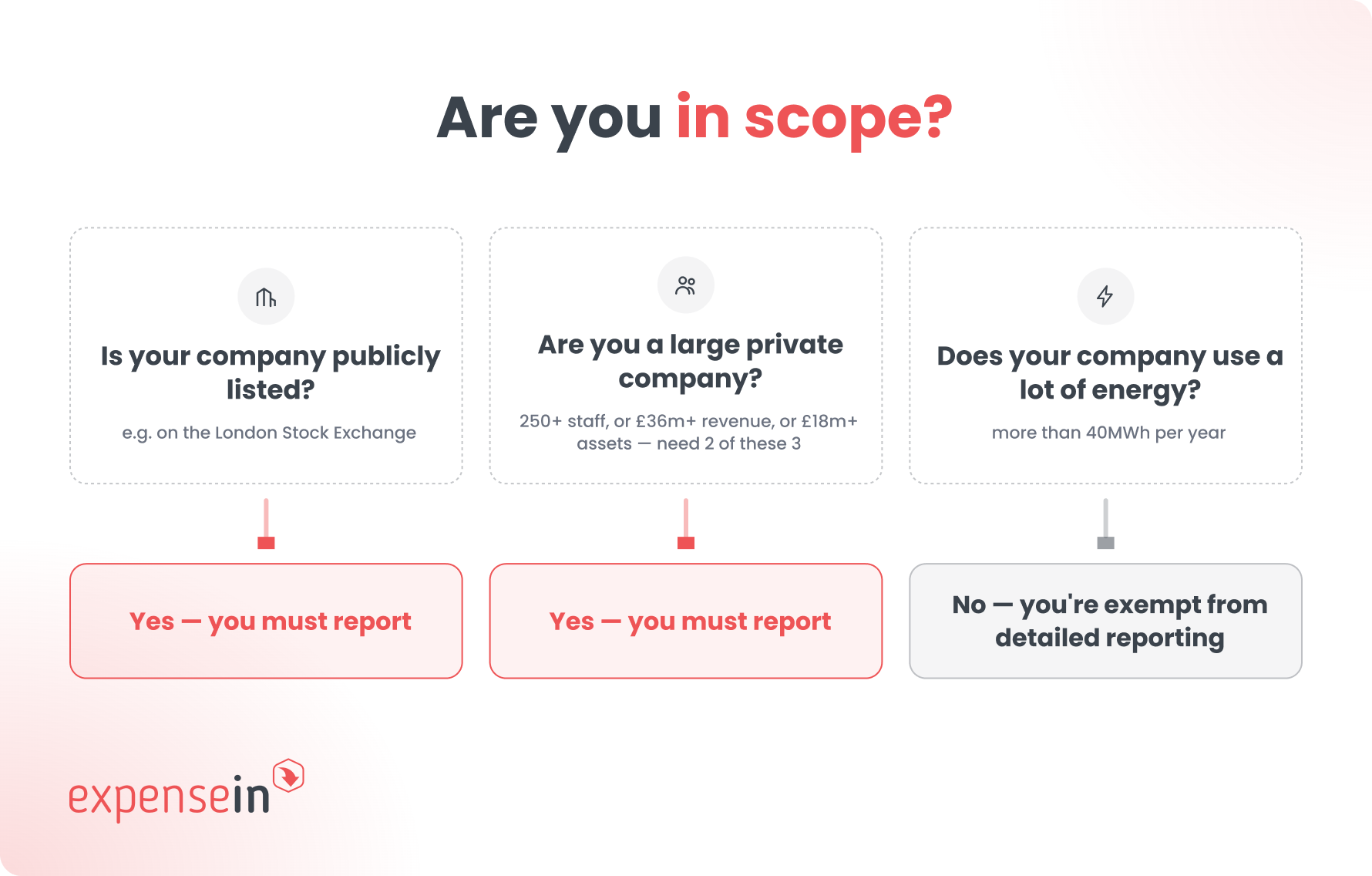
It applies to all quoted companies, plus large unquoted companies and LLPs meeting two of three thresholds: more than 250 employees, turnover above £36 million, or a balance sheet above £18 million.
Companies in scope must report their energy use, Scope 1 and Scope 2 emissions and an intensity ratio every year.
You're likely in scope if:
Your company is quoted on the London Stock Exchange, another EEA market, the New York Stock Exchange or Nasdaq
Your unquoted company or LLP meets at least two of the three size thresholds above
Your UK energy use is above 40MWh a year, ruling out the low-energy exemption
What SECR is, and why it lands on finance
SECR came into force for financial years beginning on or after 1 April 2019, replacing the earlier CRC Energy Efficiency Scheme, under the government's Environmental Reporting Guidelines.
It sits in the Directors' Report, or in a standalone Energy and Carbon Report for unquoted companies and LLPs, and is filed at Companies House alongside the annual accounts.
That's why finance ends up owning it: it's a statutory filing obligation under the Companies Act, tied to the same deadline and audit scrutiny as the rest of the annual report.
Is your business in scope? The SECR thresholds in plain terms
Quoted companies are automatically in scope, reporting on global Scope 1 and Scope 2 emissions.
Large unquoted companies and LLPs are in scope if they meet at least two of these three thresholds:
A low-energy exemption applies to both groups.
If your UK energy use is 40MWh or less across the reporting period, you don't need to make the detailed disclosures, though your report still needs to state that the exemption applies.
The 2025 threshold trap: why "medium" doesn't mean exempt
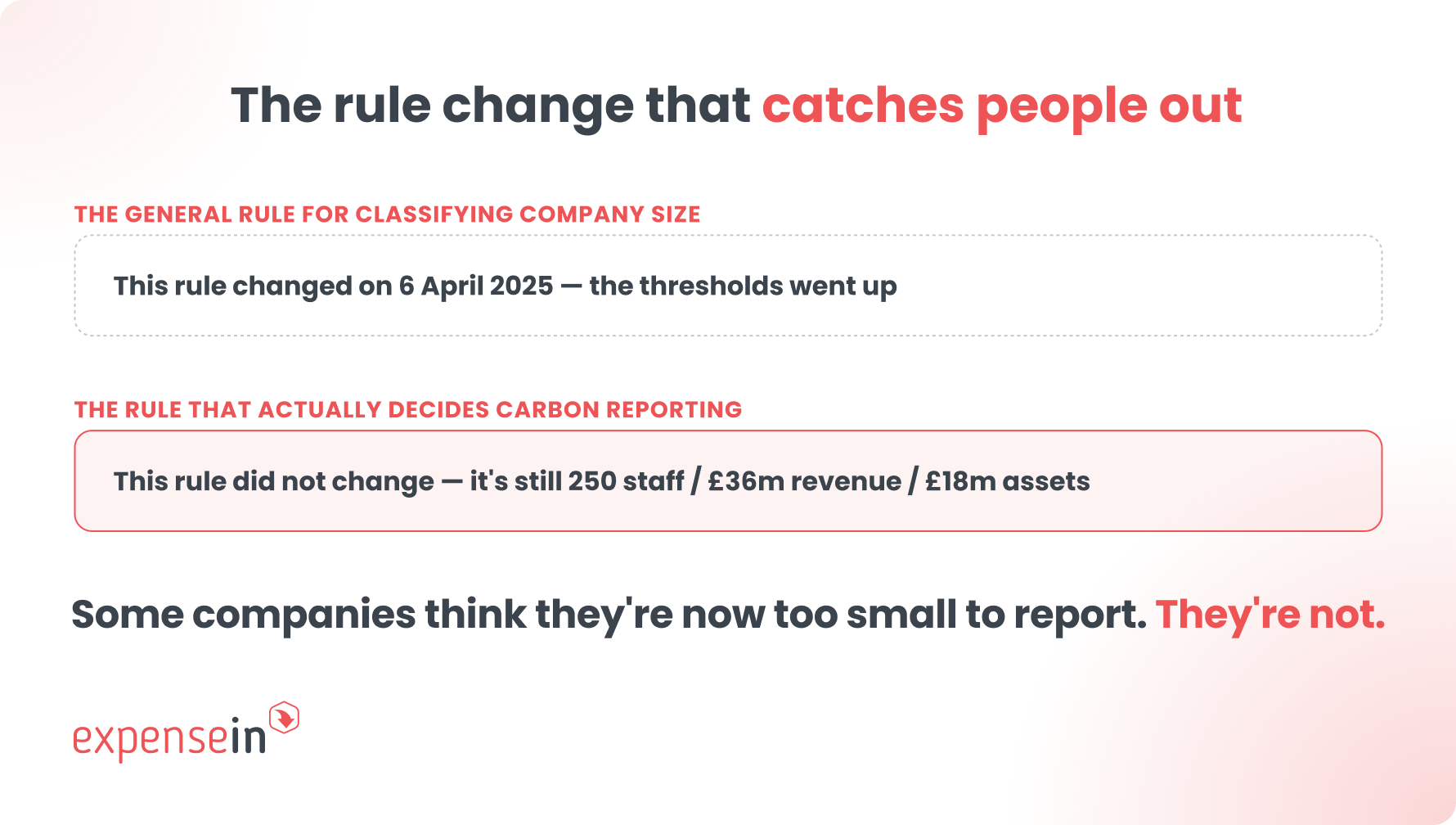
On 6 April 2025, the general size thresholds in the Companies Act were uplifted, raising the monetary bands used to decide whether a company counts as micro, small, medium, or large for most reporting purposes.
SECR's own thresholds didn't move with them. The regulations that define SECR scope still reference the pre-uplift figures directly: £36 million turnover, £18 million balance sheet, 250 employees.
The result is a genuine trap. A company that now qualifies as "medium-sized" under the new, higher general thresholds can still meet SECR's unchanged, lower thresholds and therefore still has to report.
Check your numbers against the SECR-specific figures directly. A recent reclassification to "medium" doesn't automatically take you out of scope.
What you actually have to report to meet carbon reporting requirements
For a finance team preparing the disclosure, the checklist looks like this:
UK (or global, for quoted companies) energy use in kWh
Associated Scope 1 and Scope 2 greenhouse gas emissions, in tonnes of CO2e
At least one emissions intensity ratio, such as tCO2e per £m turnover or per employee
A narrative description of the energy efficiency actions taken during the year
The methodology used to calculate the figures
Prior-year comparative figures, once you've reported for more than one year
Unquoted companies and LLPs also need to include grey-fleet Scope 3 emissions alongside the mandatory Scope 1 and 2 figures, covered next.
Scope 1, 2, and 3 emissions, without the jargon
Scope | What it covers | SECR requirement |
|---|
Scope 1: direct emissions | Fuel burned in company-owned vehicles, gas burned on your premises | Mandatory for all companies in scope |
Scope 2: purchased energy | Purchased electricity, heat, steam or cooling | Mandatory for all companies in scope |
Scope 3, grey fleet only | Business travel in vehicles the company doesn't own but pays the fuel for: employee-owned cars, rental cars | Mandatory for large unquoted companies and LLPs; voluntary for quoted companies |
Scope 3, all other categories | Supply chain, commuting, business flights and trains | Voluntary for every company type, though encouraged where material |
"Grey fleet" means business travel in an employee's own car or a rental car, where the employee claims back mileage or fuel.
Because the company doesn't own the vehicle, this would normally sit outside Scope 1, but SECR still requires large unquoted companies and LLPs to report it as a mandatory Scope 3 category.
It's the one Scope 3 disclosure you can't skip if you're an unquoted company in scope.
Where the disclosure goes, and when it's due
Quoted companies report their SECR figures in the Directors' Report. Large unquoted companies and LLPs can choose between the Directors' Report or a standalone Energy and Carbon Report filed alongside the accounts.
Either way, the filing deadline is the one your finance team already works to: the deadline for filing your annual accounts at Companies House. There's no separate SECR filing date to track.
How the emissions are calculated (and where the numbers come from)
Converting a litre of diesel or a kilowatt-hour of electricity into a tonne of CO2e requires a standard conversion factor.
In the UK, that's the government's own greenhouse gas conversion factors, published annually by the Department for Energy Security and Net Zero (DESNZ).
The methodology behind them follows the GHG Protocol, the international standard most carbon reporting frameworks are built on.
The factors change every year, largely reflecting a cleaner UK electricity grid, so using an out-of-date set skews the numbers.
The 2026 update cut the electricity factor significantly compared with 2025, mostly reflecting grid decarbonisation and a methodology change that has little to do with what any individual business actually did.
Always match the factor year to the reporting year you're calculating, not the year you happen to be compiling the report in.
The carbon data already captured in your expense claims
 When carbon reporting is due, finance teams can find themselves working backwards through fuel receipts, mileage records, and travel bookings.
But much of the underlying activity data may already have been captured through the expense process.
For example:
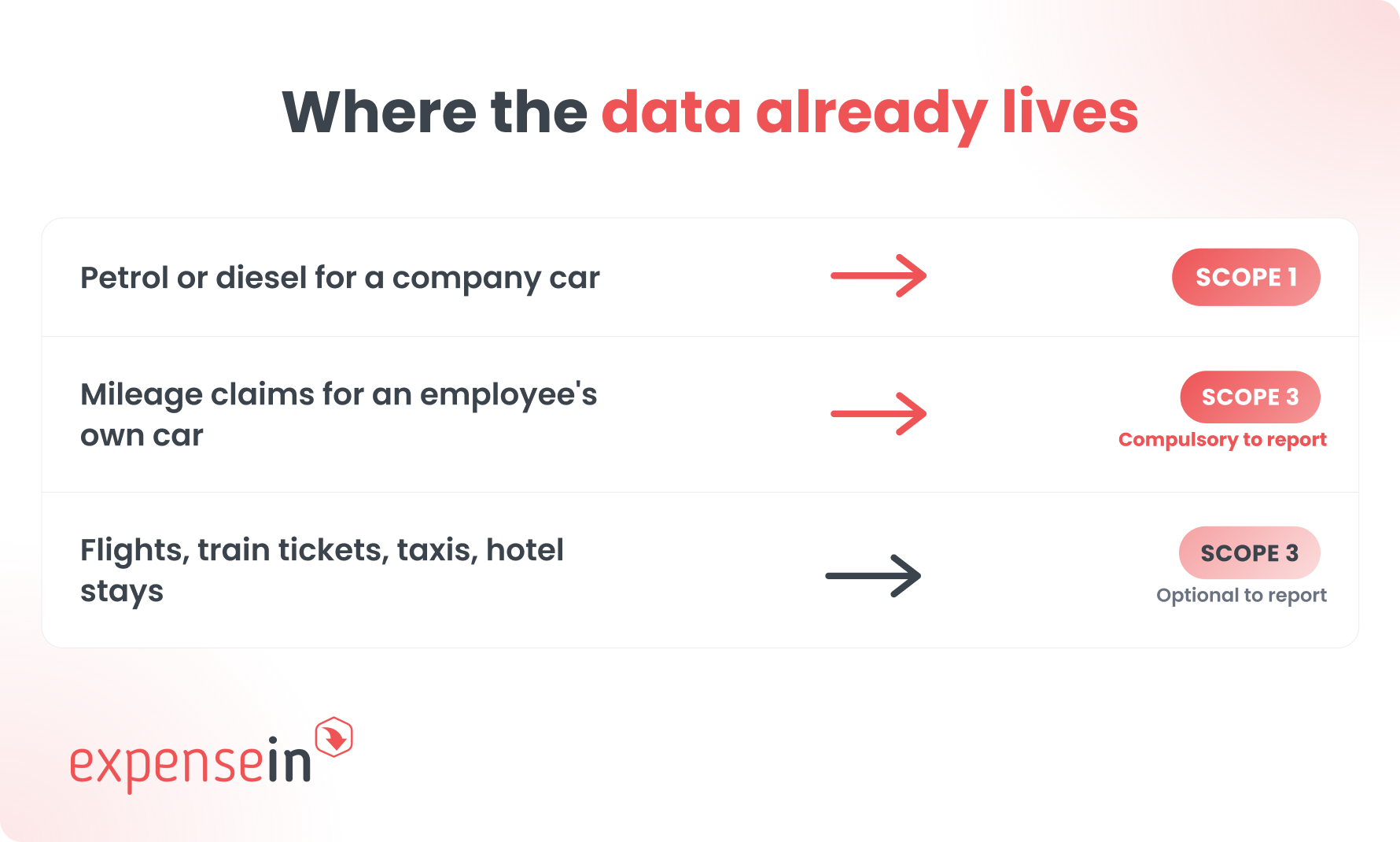
Fuel used in vehicles owned or controlled by the organisation contributes to Scope 1 emissions.
Business travel in rental cars or employee-owned vehicles falls within Scope 3. For large unquoted companies and LLPs within the scope of SECR, reporting is mandatory where the organisation is responsible for purchasing the fuel.
Flights, rail journeys, taxis, and accommodation can provide data for wider Scope 3 business travel reporting. Under SECR, these wider Scope 3 disclosures are generally voluntary, although reporting is encouraged where the emissions are material.
ExpenseIn’s carbon reporting feature calculates emissions from relevant mileage and expense claims using UK government conversion factors.
"ExpenseIn has given us the ability to start reporting on CO2 emissions to help us meet carbon reporting legislation requirements relevant to our business."
This is not a complete SECR reporting tool. Gas, electricity, building energy, and other emissions sources still require separate data.
What it provides is a cleaner travel dataset: captured during the expense process and ready to feed into the organisation’s wider carbon calculation, instead of being pieced together at year-end.
 SECR vs UK SRS: what changed in 2026, and what to do now
The UK's Sustainability Reporting Standards, UK SRS S1 and S2, were published on 25 February 2026.
They're modelled on the international ISSB standards and cover a wider range of sustainability disclosures than SECR, including climate-related risks and opportunities, not just energy and emissions.
| SECR | UK SRS (S1 and S2) |
|---|
Status | Mandatory now, for companies in scope | Voluntary now; mandatory climate reporting proposed for listed firms from 2027 |
Coverage | Energy use, Scope 1 and 2 emissions, intensity ratio | Broader sustainability and climate-related risk disclosures |
Who reports | Quoted companies, plus large unquoted companies and LLPs | Proposed for UK-incorporated listed companies from 2027 |
Where filed | Directors' Report or Energy and Carbon Report | Separate sustainability disclosure, framework still developing |
Practically, that means:
Keep reporting under SECR as normal
Don't treat UK SRS as replacing SECR yet
If your business is likely to fall into the 2027 listed-company wave, start building the underlying data now
What happens if you don't report?
SECR disclosure sits inside the Directors' Report, a statutory requirement under the Companies Act 2006. Missing it, or reporting it inaccurately, is a compliance failure carrying the same audit and filing risk as any other part of the Directors' Report.
In practice, that means auditors expect to see it, filed accounts are incomplete without it and directors carry responsibility for its accuracy.
There's no separate SECR fine sitting apart from the wider consequences of an incomplete annual filing, which is exactly why it's easy to underestimate.
It isn't a side project with its own penalty regime. It's a live part of the statutory accounts.
How to make SECR reporting less of a month-end headache
A repeatable process removes most of the pain.
Map your data sources: Utility bills for gas and electricity, fuel cards, or expense receipts for company vehicles and claims for grey-fleet mileage and other business travel
Set clear boundaries once: Agree your organisational and operational boundaries so scope isn't re-decided every year
Build a repeatable calculation process: Apply the current year's conversion factors consistently, with a documented methodology that doesn't rely on one person's memory
Automate the travel slice: Mileage and expense-related travel emissions are usually the most fragmented data source, so automating that part removes one of the most manual pieces of the process
FAQs: UK carbon reporting requirements
Yes, for companies in scope of SECR: all quoted companies, plus large unquoted companies and LLPs meeting two of the three size thresholds. Businesses outside those thresholds aren't currently required to report, though voluntary reporting is increasingly common.
SECR is the current mandatory framework for energy and carbon disclosure in the Directors' Report. UK SRS (S1 and S2), published in February 2026, is a broader sustainability and climate-risk reporting standard, currently voluntary, with mandatory climate reporting proposed for listed companies from 2027. SECR continues to apply in the meantime.
Not unless they meet the SECR thresholds. Small and micro companies, and unquoted companies below two of the three size thresholds, fall outside SECR's mandatory scope, though the framework doesn't prevent voluntary reporting.
Only one Scope 3 category is mandatory, and only for large unquoted companies and LLPs: grey-fleet emissions from business travel in vehicles the company doesn't own but pays the fuel for. All other Scope 3 reporting is voluntary for every company type.
Non-compliance is treated as a Companies Act filing issue, since the disclosure sits inside the statutory Directors' Report. That carries the same audit scrutiny and filing risk as any other inaccurate or incomplete part of the annual accounts.
Book a demo of ExpenseIn to see how expense and mileage data can give your finance team a clearer starting point for emissions reporting.


