
Business Expenses
Corporate Cards vs Expense Reimbursements: Which is Best for Your Business?
Learn the pros and cons of corporate cards and expense reimbursements, and how UK finance teams are managing both with smarter tools.
Receipts go missing. Claims pile up right before month-end close. And somewhere in the back of your mind sits a quiet worry about whether the tax side is being handled correctly.
Most finance teams reach this point simply because the process has outgrown ad hoc handling.
Reimbursing employee expenses properly comes down to five things: a written policy, an easy way to submit claims and receipts, consistent approval against that policy, a payment route through payroll or as a separate payment, and records that hold up if HMRC asks questions. Get those five right and the tax treatment mostly follows.
This guide covers each step, the tax rules underneath it, and the mileage and subsistence figures for 2026/27.
Note: This guide is not written to replace professional advice. It's general information rather than tax advice, HMRC's rules and rates can change, and every business's circumstances are different. Always check the latest guidance on GOV.UK or speak with a qualified accountant before making decisions based on it.
No general UK statute says you must reimburse an employee for money they've spent on your business.
What usually creates the obligation is your employment contract. Most contracts include an express or implied term that reasonable business expenses, properly incurred, will be repaid. Refuse to honour that and an employee's recourse is a breach of contract claim through the courts or a tribunal.
In practice, reimbursing expenses is standard good practice across UK employers. Staff expect it, it supports recruitment and retention, and skipping it tends to push costs onto employees, who then simply stop spending on the business's behalf.
This is a contractual obligation, and your contract or staff handbook is where it actually lives.
HMRC's own guidance sets out the test directly:
"To be deductible from the earnings of an employment an expense must be incurred wholly and exclusively in the performance of the duties of the employment."
The expense must also be incurred necessarily in the performance of the employee's duties. All three conditions have to be met. Miss one and the payment usually becomes taxable.
Reimbursable tax-free | Not reimbursable tax-free |
|---|---|
Business travel (train, flights, taxis, mileage) | Ordinary commuting between home and a permanent workplace |
Mileage at or below HMRC's approved rate | Mileage paid above the approved rate without reporting the excess |
Overnight accommodation for business trips | Personal living costs unrelated to work |
Subsistence within HMRC's benchmark scale rates | Client entertainment (this has separate, stricter rules) |
Home-working equipment needed to do the job | General "nice to have" personal purchases |
Professional subscriptions on HMRC's approved list | Subscriptions unrelated to the employee's role |
Failing the test on one claim doesn't disqualify the whole process. That cost simply needs to go through payroll as taxable pay instead of being reimbursed tax-free.
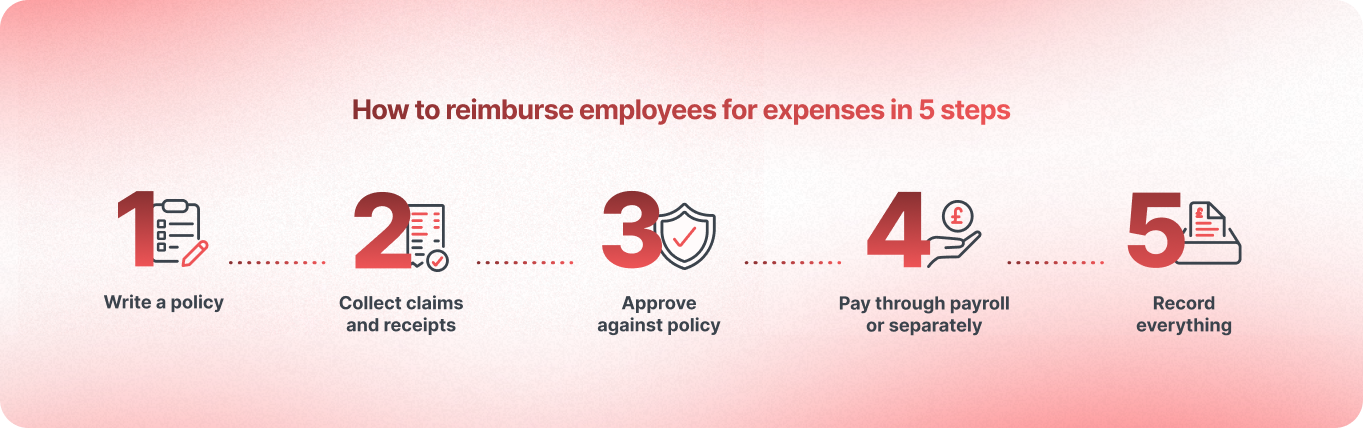 1. Write an expense policy people actually follow
 An expense policy that sits in a folder nobody opens creates a liability that surfaces at audit time.
Set out, in plain language, what counts as an eligible cost, any spending limits, submission deadlines and who needs to approve what. If your team travels internationally or claims mileage regularly, spell those out specifically so people don't have to guess.
The goal is to answer the questions your team actually asks: can I claim this, how much and by when.
Every month-end, finance teams lose hours chasing the same three people for the same missing receipts. Usually that traces back to how the process is designed.
A valid claim needs a receipt or invoice, the business reason and the date. For mileage, a log beats a fuel receipt every time, since HMRC's approved rate already covers running costs.
Whatever format you use, make submission easy enough that people do it as they go, before a month of claims piles up into one panicked Friday.
Treat approval as a compliance check: does the claim match policy, yes or no. If it doesn't, flag it before payment goes out.
Set clear thresholds for who signs off what. A £15 taxi claim doesn't need the same scrutiny as a £2,000 conference bill. Consistency matters here more than strictness: applying the rules unevenly across the team is what tends to trigger disputes and, eventually, HMRC's attention.
Both routes are legitimate.
Payroll works well when mileage or subsistence is claimed regularly and paid at or under HMRC's approved rates, since it slots into a process you're already running.
A separate bank payment often suits one-off or larger claims, particularly where VAT needs separate handling.
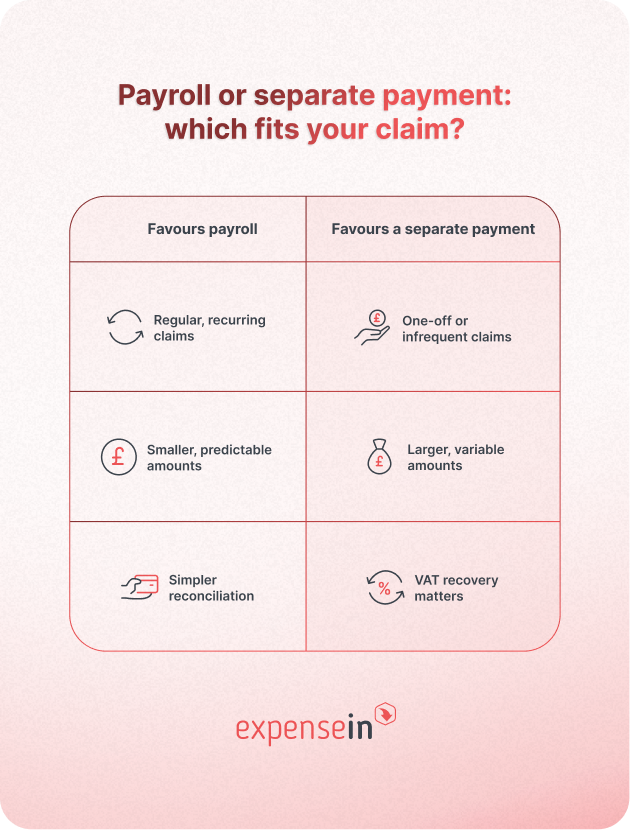 It's one of the decisions finance teams get wrong most often, covered in detail in the next section.
HMRC expects you to keep records of expenses and benefits provided to employees, generally for three years from the end of the relevant tax year. That includes evidence the claim was genuine, alongside the amount paid.
Done well, this step is invisible. Done badly, it's the difference between a routine HMRC query taking ten minutes to answer and taking two weeks to reconstruct.
For most reimbursable costs, yes. HMRC expects evidence that a business cost was genuinely incurred, and a VAT invoice matters specifically if you plan to reclaim input VAT on the expense.
"You’ll need to keep a record of the date and details of every expense or benefit you provide, any information needed to work out the amounts you put on your end-of-year forms, and any payment your employee contributes to an expense or benefit. You should also keep any correspondence you have with HMRC.You must keep records for 3 years from the end of the tax year they relate to.”
Mileage works differently. Since HMRC's approved mileage rate already bundles in fuel, insurance, servicing and wear, a fuel receipt isn't proof of a business journey. What you need instead is a mileage log: date, route, purpose, and distance.
Subsistence sits in between. If you're using HMRC's benchmark scale rates (more on those shortly), you no longer need to check every individual receipt, provided you can still evidence that a qualifying business journey took place.
This is where much of the manual work in expense management comes from, and there's rarely a single right answer.
Factor | Favours payroll | Favours a separate payment |
|---|---|---|
Claim frequency | Regular, recurring claims (mileage, subsistence) | One-off or infrequent claims |
Claim size | Smaller, predictable amounts | Larger, variable amounts |
VAT recovery | Limited relevance | Important where input VAT needs reclaiming |
Payment speed needed | Tied to your payroll cycle | Can be paid faster, outside the cycle |
Reconciliation | Simpler, one payment stream | Needs its own tracking and matching |
Many finance teams run both: payroll for routine mileage and subsistence, and a separate payment route for larger or ad hoc claims, matching the method to the shape of the claim.
There's no statutory deadline for reimbursing expenses in the UK, and that's often why the timing slips.
Good practice is to set your own service-level target and stick to it, commonly within 5 to 10 working days of an approved claim. Slower than that and employees quietly stop claiming smaller costs, which pushes the cost back onto their personal cash flow and erodes goodwill over time.
Treat the timing commitment as part of your expense policy. A written SLA gives your team a standard to hold finance to, and gives finance a clear target to plan around.
Reimbursements that pass the wholly, exclusively and necessarily test, and stay within HMRC's approved rates, are not taxable income for the employee and don't need reporting.
Where a payment exceeds the approved rate, or doesn't meet the test, the excess becomes a benefit in kind. You have two main reporting routes:
Payrolling benefits, where the value is added to taxable pay and taxed through PAYE in real time via your Full Payment Submission.
P11D and P11D(b), reported after the tax year ends, with Class 1A National Insurance due on the taxable value at the employer's rate.
If you haven't registered to payroll benefits with HMRC before the start of the tax year, you'll need to use P11D reporting for that year instead.
Either way, the underlying principle is the same: pay within the approved rates and there's nothing to report; pay above them and the excess needs declaring.
Mileage is where most of the confusion sits, and 2026/27 brought a genuine change.
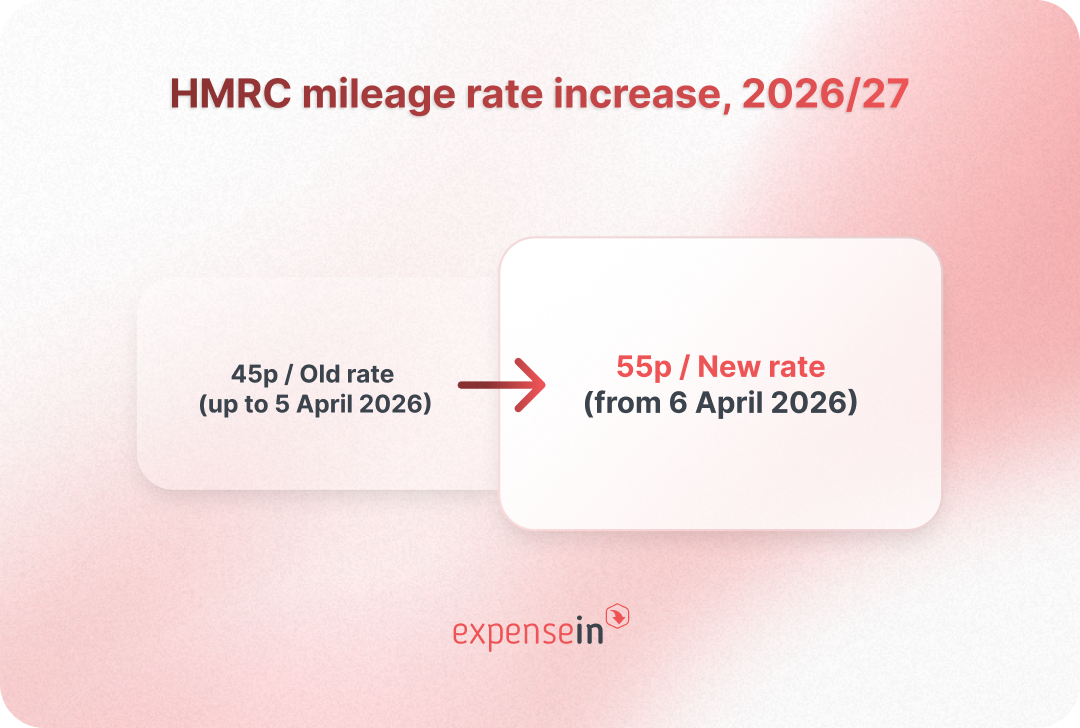 HMRC's approved mileage rate for cars and vans increased from 45p to 55p per mile for the first 10,000 business miles in the tax year, backdated to 6 April 2026. The rate above 10,000 miles stays at 25p per mile. Motorcycles remain at 24p per mile and bicycles at 20p per mile, both unchanged.
Worked example: An employee driving 8,000 business miles in their own car during 2026/27 can be paid up to £4,400 tax-free (8,000 × 55p). Someone driving 12,000 miles would receive 10,000 × 55p (£5,500) plus 2,000 × 25p (£500), a total approved amount of £6,000.
Because the increase was announced partway through the tax year, some employers had already reimbursed staff at 45p per mile for journeys made since 6 April 2026.
If that applies to you, you can top up those earlier payments to the new 55p rate: the increase applies from 6 April 2026, not from the date it was announced.
A few related points for your team:
If you pay less than the approved rate, employees can claim Mileage Allowance Relief on the shortfall, either through Self Assessment or, for smaller amounts, via form P87.
If you pay more than the approved rate, the excess is taxable and needs reporting, typically via P11D.
Company car drivers use Advisory Fuel Rates instead of AMAP, since a different vehicle-ownership situation applies.
VAT-registered businesses can generally reclaim VAT on the fuel element of a mileage payment, provided the employee holds a valid VAT fuel receipt covering the relevant period.
Method | Best for | Watch out for |
|---|---|---|
Bank transfer | One-off or larger claims outside payroll | Needs its own reconciliation and tracking |
Payroll | Regular mileage and subsistence at approved rates | Ties reimbursement timing to the payroll cycle |
Prepaid or company expense cards | Frequent, smaller, predictable spend | Requires clear card policy and spend controls |
Subsistence on qualifying trips | Only valid where the qualifying conditions are genuinely met |
None of these is universally "best."
The right mix depends on how often your team claims, how large the claims are and how much manual reconciliation your finance team can absorb before it starts to hurt.
HMRC generally expects expense and benefit records to be kept for three years from the end of the tax year they relate to.
In practice, that means being able to show, for any given claim: what was paid, why, to whom, when it was approved and by whom.
The paper-based version of this is a shoebox of receipts and a hope that nothing gets asked about. The digital version is a system where every claim already carries its evidence, approval trail and coding, so a query is a five-minute lookup rather than a week of archaeology.
Going digital doesn't eliminate the underlying rules, but it keeps every claim a few clicks from proof.
None of the process above requires software. Plenty of smaller teams run it well on spreadsheets and a shared drive.
Where it tends to break down is volume. Once you're chasing dozens of claims a month, running mileage logs manually, and reconciling two payment routes by hand, the five-step process above starts eating real finance-team hours every month.
That's the specific gap expense management software like ExpenseIn is built to close.
Claims submitted with receipts attached from the start
Mileage calculated automatically against the current HMRC rate
Approvals routed automatically by policy instead of by email
A full audit trail sitting behind every payment
The rules stay the same; the manual time spent enforcing them drops.
 Employee expense reimbursement FAQs
 Usually not for standard costs, since HMRC expects evidence a business cost was genuinely incurred.
Mileage is the exception, where a mileage log replaces a fuel receipt, and HMRC's benchmark subsistence rates (£5 for 5+ hours, £10 for 10+ hours, £25 for 15+ hours where travel continues past 8pm) can be paid without checking individual receipts, provided the qualifying journey conditions are met.
Not if they meet the wholly, exclusively and necessarily test and stay within HMRC's approved rates.
Anything paid above the approved rate, or that fails the test, becomes taxable as a benefit in kind and needs reporting through payrolling or P11D.
There's no statutory deadline. Good practice is to set your own policy target, commonly 5 to 10 working days from an approved claim, and hold to it consistently.
Yes. Paying expenses through payroll works particularly well for regular mileage and subsistence claims paid at or under HMRC's approved rates, since it uses a payment process you're already running.
55p per mile for the first 10,000 business miles in a car or van, and 25p per mile after that, backdated to 6 April 2026. Motorcycles remain at 24p per mile and bicycles at 20p per mile.
💡 Book a demo to see how ExpenseIn can take the manual work out of expense claims, mileage, and approvals, while keeping every payment audit-ready.
Learn the pros and cons of corporate cards and expense reimbursements, and how UK finance teams are managing both with smarter tools.