
Business Expenses
Employee Travel Expenses: What UK Employers Need to Know
Learn everything there is to know about employee travel expenses, including what workers can claim, the benefits of a travel and expense policy, and more.
Receipts pile up in a coat pocket until they're too creased to read. Mileage gets worked out from memory at the end of the month. An expense claim needs three approvals and two reminder emails before it gets paid.
And travel spend? Finance usually finds out what it actually cost once the month is closed, not before.
If that sounds familiar, you're not looking for another accounting tool. You're looking for travel expense management software.
Travel expense management software captures, checks, approves, and reports the costs employees run up while travelling for work:
Hotels
Meals
Rail fares
Parking
And the rest
It removes the paper trail and the spreadsheets.
A claim gets submitted from a phone, checked against policy automatically, routed to the right approver, and posted straight into the accounting system, correctly coded and with VAT already separated out.
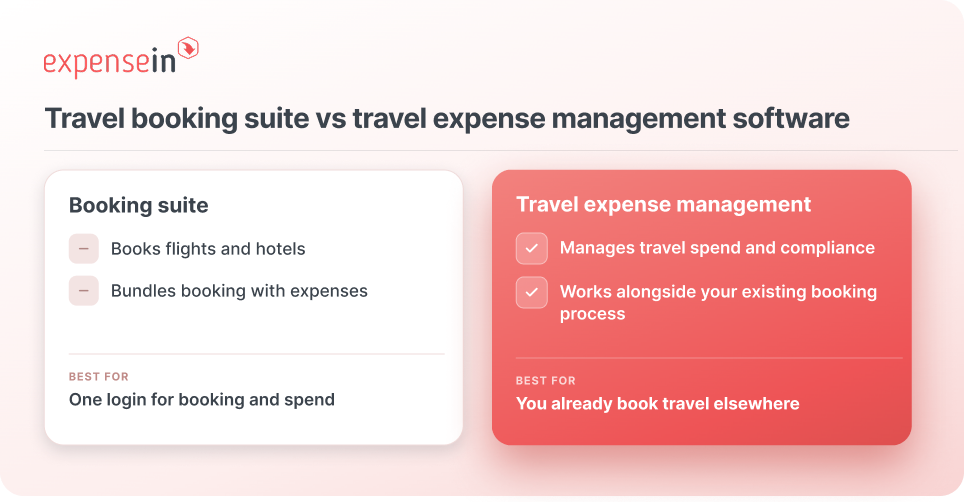 The two terms get used interchangeably, and that's usually where the buying decision goes wrong.
T&E suites bundle two separate jobs together: booking the trip (flights, hotels, rail) and managing what it costs once the employee is on the road.
Travel expense management software is narrower by design. It handles the money side only: capturing spend, checking it against policy, running approvals, and getting the numbers into the ledger.
That difference decides how big a platform you actually need, and it's worth being clear on before you start comparing vendors.
What it does | T&E (booking-led) suite | Travel expense management software |
|---|---|---|
Books flights, hotels, rail | Yes, built in | No, sits alongside your existing booking process |
Captures receipts and mileage | Yes | Yes |
Approval workflows and policy checks | Yes | Yes |
VAT and HMRC compliance handling | Varies by provider | Built specifically for this |
Accounting system sync | Varies by provider | Core function |
Best suited to | Businesses that want one login for booking and spend | Businesses that already book travel elsewhere and want tighter control over what it costs |
Travel expense management software typically manages the process from the moment an employee spends money through to approval and accounting.
The basic flow looks like this:
The employee records the expense. Instead of saving receipts and mileage records until they return, employees can capture costs as they happen. That might mean photographing a receipt, logging a journey for mileage, or matching an expense to a company card transaction.
The expense is checked against company policy. The expense software can check details such as mileage rates, spending limits, and receipt requirements. Expenses that fall outside the rules can be flagged before they reach an approver, giving finance teams the chance to deal with exceptions earlier.
The claim goes to the right approver. Approval workflows can route expenses based on factors such as the employee, value of the claim, or cost centre. That reduces the need for finance to manually work out who needs to approve what.
Approved expenses move into the accounting workflow. Once approved, expense data is automatically coded and passed into the accounting system, reducing manual re-entry.
Finance gets an up-to-date view of travel spend. Rather than waiting for outstanding claims to arrive at month-end, finance can see submitted and approved spend as it moves through the process with real-time reporting. That makes it easier to spot missing claims, monitor costs, and prepare for close.
Most feature lists read like a spec sheet. The features below are the ones that actually change what finance has to do each month, not just what a demo can show.
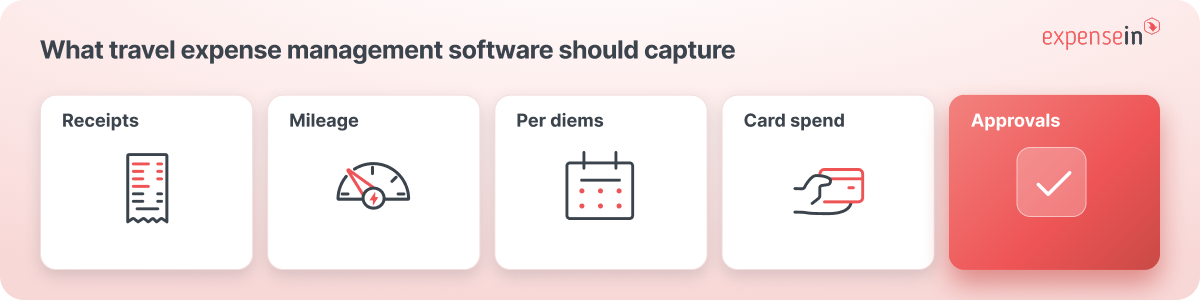
A photo of a receipt should be enough. OCR technology reads the amount, date, vendor, and VAT automatically, then matches it against a card transaction if one exists.
That's the difference between someone typing a claim in by hand and finance reviewing something that's already populated correctly.
Mileage should be captured at the point of travel, not reconstructed from memory weeks later. The approved mileage rates should update automatically when HMRC updates them, so nobody on the finance team is manually editing a formula or a policy field every time a new rate takes effect.
With the rate rising to 55p a mile for the first 10,000 business miles from 6 April 2026, that automatic update matters more than it used to.
Where a business applies subsistence or per diem allowances, the expense system should apply the correct scale rate automatically based on how long the employee was away, rather than leaving someone to work out which threshold applies and whether the claim matches it.
Card feeds should reconcile against claims automatically. When a transaction comes in from a company expense card, it should sit alongside the matching claim rather than needing someone to cross-check a statement against a stack of receipts at month-end.
This is one of the quickest wins for reducing manual reconciliation time.
Approval routing should reflect how your business actually works: by department, cost centre, spend threshold, or seniority.
Just as important is a policy engine that flags a breach automatically, a claim over the mileage rate, a receipt missing above the required value, rather than relying on an approver to spot it.
 That's what keeps non-compliant spend from slipping through in the first place.
VAT treatment on travel isn't uniform. Fuel, rail, air travel, and hotel stays can all be treated differently, and getting it wrong either means missing a legitimate reclaim or overstating one.
The expense management software should separate and flag the VAT position on each travel line as the claim comes in, not leave finance to check every fuel receipt and hotel invoice by hand at quarter-end.
Always confirm the correct VAT treatment for specific circumstances with your accountant, since it can depend on the type of expense and how it's evidenced.
Finance shouldn't have to wait until month-end to know what travel costs.
Live dashboards showing spend by department, project, or employee mean travel budgets can be managed in real time, not reconciled after the fact.
If your business books flights and hotels through a travel management company, a corporate booking portal, or directly with airlines and hotels, it's easy to assume you need one platform that does booking and expense management together.
In practice, that's usually not the case.
Booking-led suites are built to sell booking first, and expense management is often the add-on.
Finance teams frequently end up with software that's strong at capturing a flight booking and comparatively weak at the things that matter for a clean close, like:
Policy enforcement
VAT handling
HMRC-compliant mileage
And getting data into the accounting system
If you already have a booking process that works, whether that's a travel management company, a corporate airline account, or direct booking, a focused expense platform that connects to that process usually gives you a tighter, more accurate view of spend.
You're not paying for booking functionality your team doesn't use, and you're not compromising on the expense side to get it.
Compliance is where generic expense tools fall short, and where UK-specific expense software should do the heavy lifting automatically.
From 6 April 2026, the HMRC mileage rate for the first 10,000 business miles rises to 55p per mile, up from 45p.
Travel expense management software should apply the current rate automatically and update it the moment HMRC changes it, so finance isn't relying on someone remembering to update a spreadsheet formula or a policy setting.
HMRC's benchmark subsistence scale rates are £5 for trips of 5 hours or more, £10 for 10 hours or more, and £25 for 15 hours or more, or where the employee is away for a full 24 hours.
VAT recovery on travel is one of the easiest places for a business to either under-claim or over-claim, because the treatment differs by expense type.
Software that flags the VAT position on each line as the claim is submitted means finance can review with confidence rather than working it out retrospectively.
An auditor wants the receipt, the approval, and the policy check, all attached to the same transaction.
Software that keeps that trail intact automatically is worth more at audit time than a slightly faster claim now.
If a business can't reconstruct who approved a claim and why within a couple of clicks, that's worth testing before buying.
The case for travel expense management software isn't really about saving time on individual claims, although it does that too. It's about what finance can see and control across the business.
Global business travel spend reached $1.57 trillion in 2025, with 8.1% growth forecast for 2026.
As travel volumes keep growing, the gap between manual processes and proper control widens with them. A business handling this on spreadsheets today will feel that gap more, not less, next year.
The practical benefits for finance teams:
Faster reimbursement, because claims don't sit waiting for a manual check
Real-time visibility into travel spend, rather than a total that only appears after month-end
Fewer non-compliant claims reaching approval, because policy is enforced automatically
A faster, cleaner month-end close, because claims arrive coded and VAT-separated
Stronger audit trails, because the receipt, approval and policy check travel together automatically
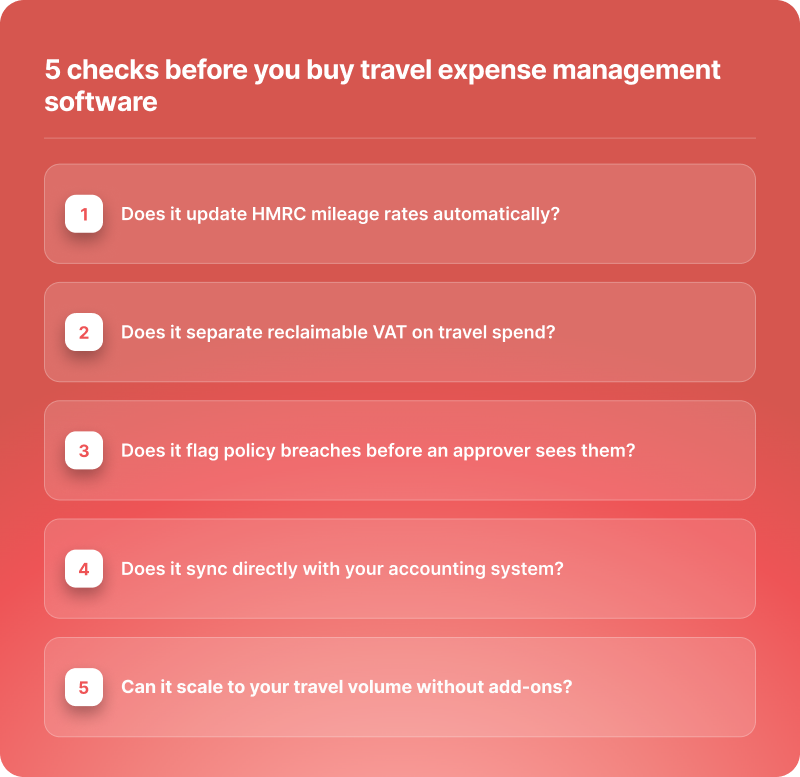
A feature list only tells you so much. The checklist and questions below are built to test whether a platform holds up once it's actually running your travel spend.
Does it update HMRC mileage and subsistence rates automatically?
Does it separate and flag reclaimable VAT on travel spend?
Does it flag policy breaches before an approver sees the claim?
Does it sync directly with your accounting system, coded correctly?
Does it give real-time visibility into travel spend by department or project?
Can it scale with your travel volume without needing extra add-ons?
A demo will show you the interface. These questions show you whether it'll hold up in practice:
How does the platform handle a mileage rate change, and how quickly?
Can you show a claim moving from submission to approval to posting in the accounting system?
How is VAT treated differently across expense types inside the platform?
What happens to a claim that breaches policy? Does it get blocked, flagged, or approved anyway?
Which accounting systems does it integrate with natively, and which need manual export?
What does implementation and onboarding involve, and how long does it typically take?
Already have travel booking covered? ExpenseIn handles the spend side.
As travel expense management software, ExpenseIn helps finance teams:
Capture receipts and track mileage as expenses are submitted
Apply policy rules and approval workflows before claims are processed
Track company card spend alongside employee expenses
See spend as it happens through real-time reporting
Move approved expense data into existing accounting workflows
ExpenseIn doesn’t replace the way your team books flights, hotels, or rail. It focuses on what happens around that booking: capturing the cost, checking it, approving it, and getting the right data into finance.
 Travel Expense Management Software FAQs
A travel booking tool books flights, hotels, and rail. Travel expense management software manages what that travel costs once the employee is on the road:
Capturing receipts and mileage
Checking spend against policy
Running approvals
Getting the numbers into the accounting system
Some platforms do both. Many UK finance teams only need the second one.
Good travel expense management software applies HMRC mileage and subsistence rates automatically and updates them when HMRC changes them, including the rise to 55p per mile for the first 10,000 business miles from 6 April 2026.
It should also flag the VAT position on each travel line so finance can reclaim what's eligible without manually checking every receipt.
ExpenseIn integrates with:
It also supports CSV/file exports and a REST API for other accounting workflows.
Pricing usually depends on the number of users and which features you need, such as mileage tracking, card reconciliation, or invoice approval.
The most reliable way to get an accurate cost for your team is to book a demo and talk through your requirements directly.
It's usually worth it once a business has enough travel volume that manual claims, mileage tracking, or reconciliation are taking up real finance time each month.
For a very small team with occasional travel, a simpler process may still be manageable.
As travel volume grows, so does the value of automatic policy checks, HMRC-compliant rates, and a direct accounting sync.
Book a demo to see how ExpenseIn can bring your travel expense management under control.
Learn everything there is to know about employee travel expenses, including what workers can claim, the benefits of a travel and expense policy, and more.

