Cashback can turn everyday business spending into a useful financial return. And finance leaders are paying attention.
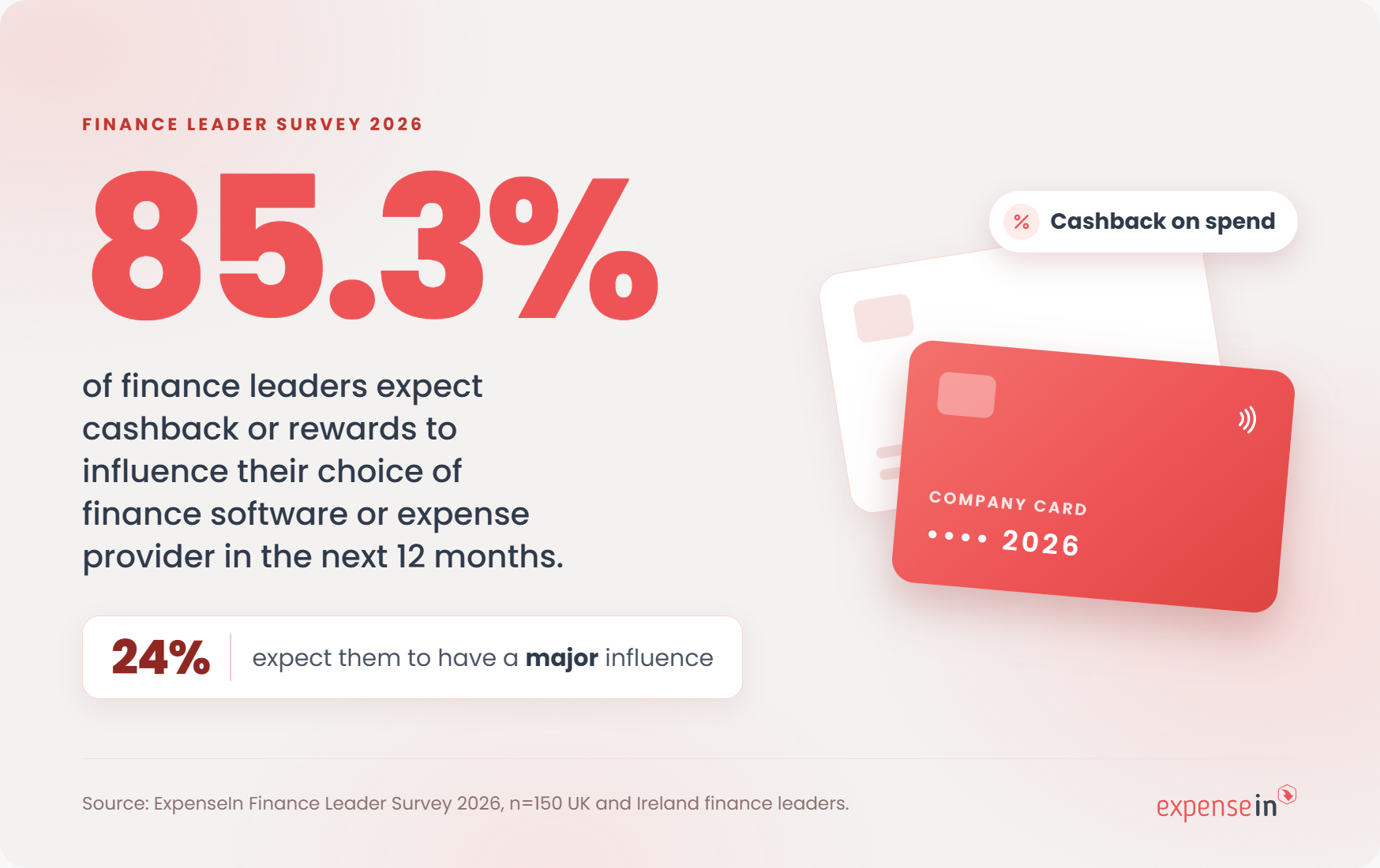
ExpenseIn’s 2026 Finance Leader Survey found that 85.3% of finance leaders across the UK and Ireland expect cashback or rewards to influence their choice of finance software or expense provider over the next 12 months. Nearly a quarter (24%) expect them to have a major influence.
The opportunity is clear: earn something back on business spending you already need to make, while keeping that spend visible and controlled.
The key is knowing how cashback works, what your business can realistically earn and how it fits into the wider expense process.
What is cashback on business expenses?
Cashback on business expenses is a reward that returns a percentage of eligible company spending to the business.
For example, if £10,000 of eligible spend earns 1% cashback, the business receives £100. The actual return depends on what qualifies: providers may exclude certain transactions, cap earnings, or offer different rates by plan or type of spend.
Business cashback can be offered through credit, debit or expense cards. For finance teams, the key is to compare the headline rate with eligibility and any fees or interest to understand the real value.
How does business cashback work?
Business cashback works by applying a reward rate to qualifying card transactions, then crediting the cashback to the business according to the provider’s terms.
In practice, there are three steps:
You make an eligible business purchase.
Cashback accrues at the applicable rate.
The reward is credited according to the provider’s terms and payment schedule.
To compare cashback offers accurately, it can help to look beyond the headline rate and calculate your effective cashback rate:
Effective cashback rate = cashback received ÷ total card spend × 100
For example:
| Amount |
|---|
Total card spend | £100,000 |
Spend that qualifies for cashback | £70,000 |
Headline cashback rate | 1% |
Cashback earned | £700 |
Effective cashback rate | 0.7% |
The provider may advertise 1% cashback, but across the business’s full £100,000 of card spend, the effective return is 0.7%.
That gives finance a more useful number to work with when comparing different options.
What business expenses can earn cashback?
The spending that earns cashback depends on the provider and its current terms. Depending on the programme, everyday categories such as business travel, software subscriptions, supplies, and supplier costs may be relevant.
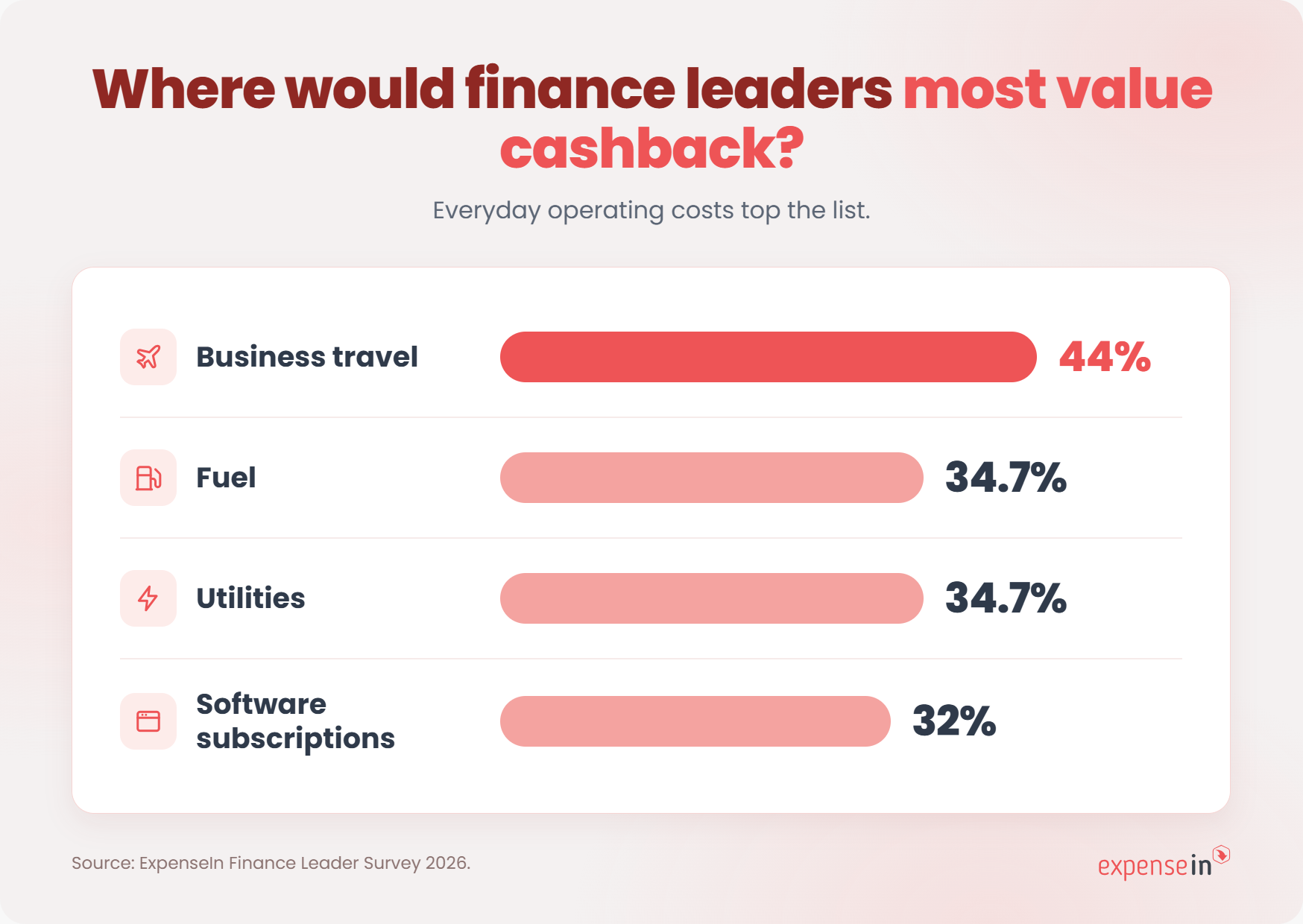
ExpenseIn’s survey gives a useful indication of where finance leaders most want to see cashback:
That suggests the appeal is practical: finance teams are interested in earning something back on recurring and necessary business costs rather than creating new spending simply to chase rewards.
Supplier spend can be relevant too. Department for Business and Trade research found that 34% of 300 businesses surveyed paid suppliers by credit card, while 23% used debit cards.
How do you know which spend qualifies?
Check the provider’s current terms before forecasting your cashback.
Useful questions include whether there are transaction or merchant exclusions, how refunds and reversals are treated, whether overseas spend qualifies, and whether any caps or thresholds apply.
The goal is simply to build your forecast around the spending that can genuinely earn it.
How do you work out whether business cashback is worth it?
Cashback tends to be most valuable when it rewards spending your business was going to make anyway, without introducing unnecessary cost or admin.
That matters to finance leaders. 70.7% of respondents in ExpenseIn’s survey rated cashback itself as an important feature when choosing a finance platform, rising to 76% among respondents in Ireland.
A simple way to assess the financial return is:
Net cashback value = cashback earned – incremental fees – interest – FX costs – other incremental costs
Then apply the calculation to your actual spending:
Check | What finance should look at |
|---|
Eligible spend | How much of your existing business spend could realistically earn cashback? |
Rate and limits | What rate applies and are there caps, thresholds or plan conditions? |
Relevant costs | Would using the payment method introduce fees, interest or FX costs you would not otherwise incur? |
Finance process | How easily can the resulting transactions, receipts, approvals and reporting be managed? |
For credit-based cashback products, borrowing costs form part of that calculation. For other card models, assess the costs and terms that actually apply to that product.
The goal is to identify where cashback can add a worthwhile return to spending your business already makes.
And financial value is only half the picture. If the card also makes that spend easier to capture, approve, and reconcile, the wider benefit to finance can be greater than the cashback figure alone.
Is cashback on business expenses taxable?
Yes. For a UK business, cashback received in the course of trading is included in taxable trading profits, according to HMRC.
HMRC distinguishes this from ordinary personal cashback received by someone who is not carrying on a trade or property business, which does not generally fall within the miscellaneous income rules.
For finance teams, the key distinction is that business cashback earned through trading forms part of taxable trade profits.
But tax is only one part of the picture. You also need to decide how the cashback should be recorded in your accounts.
How should you account for business cashback?
There is no single accounting treatment for every cashback arrangement.
In the UK, the right approach depends on what the cashback relates to, who provides it, and your accounting policies.
For finance teams, focus on three things:
Question | What to do |
|---|
How should the cashback be recorded? | Confirm whether it should be shown separately or treated against the related cost, based on the specific arrangement and your accounting framework. |
Can you trace it? | Keep the original transaction, provider statement, cashback calculation and final credit together in the audit trail. |
Can the treatment be automated? | Only automate coding once the correct treatment for that cashback programme has been agreed. |
The important point is consistency. Whatever treatment you use should reflect the arrangement and be applied the same way across similar transactions.
Does cashback affect VAT?
Yes, cashback can affect VAT, but the treatment depends on who provides the cashback and how the arrangement works.
HMRC’s VAT Notice 700/7 distinguishes between two important scenarios:
Cashback arrangement | VAT treatment described by HMRC |
|---|
Cashback from a manufacturer | If a VAT-registered business receives cashback relating to a purchase, it reduces the taxable value of that purchase. The business must reduce the associated input VAT accordingly. |
Cashback from an intermediary | If the cashback comes from an intermediary that did not provide the underlying goods or service, it does not reduce the amount paid for that original supply. |
For finance teams, the practical question is: who is providing the cashback, and what does the payment relate to?
HMRC notes that its examples are not exhaustive, so check your specific arrangement against current guidance and take professional advice where appropriate.
What should finance teams compare before choosing a cashback card?
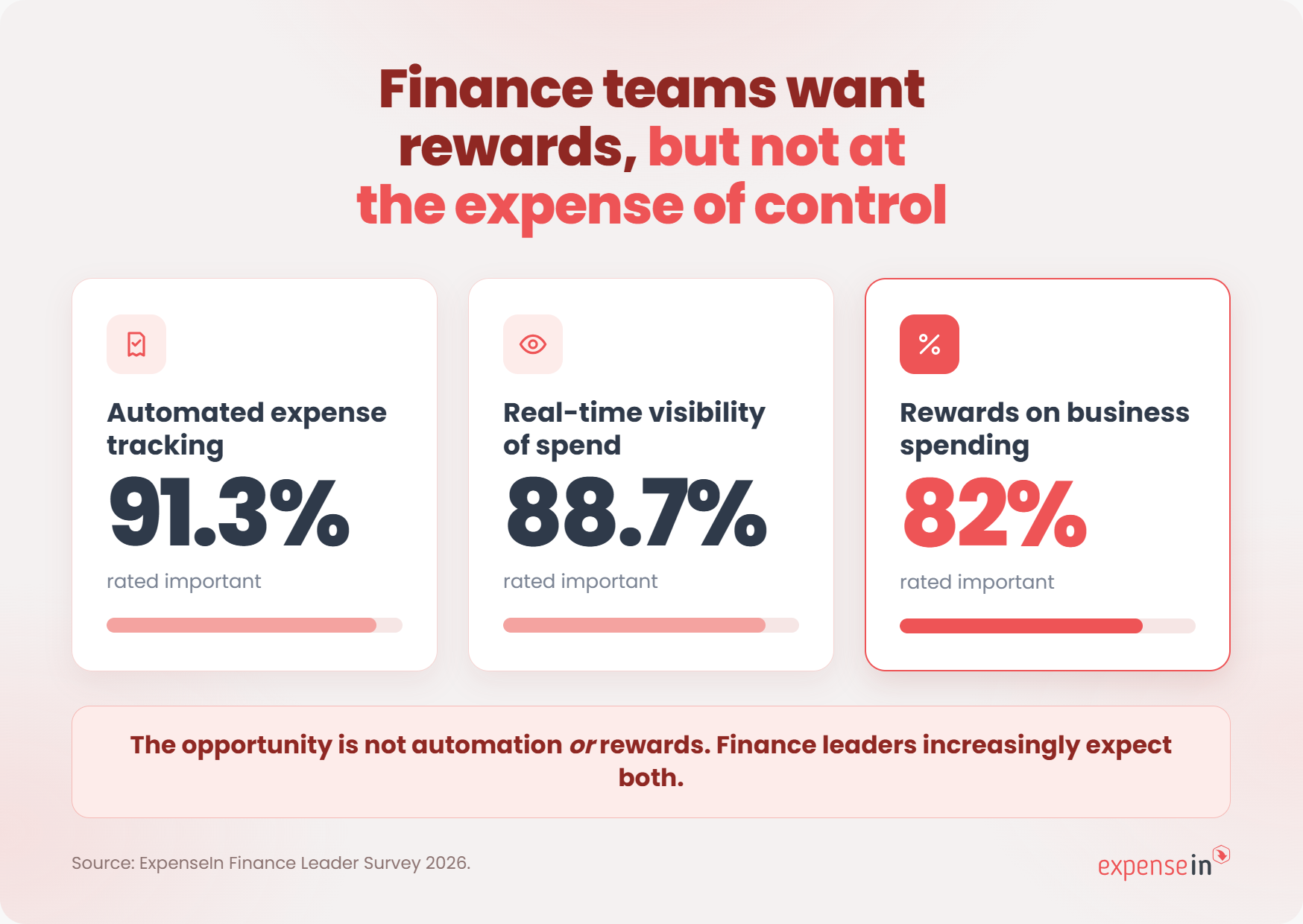
Cashback matters, but ExpenseIn’s research suggests finance leaders increasingly want rewards and strong expense management.
While 82% said rewards on business spending are an important platform feature, automated expense tracking scored even higher at 91.3%, followed by real-time visibility of spend at 88.7%.
That is a useful way to assess a cashback card: look at the reward, then look at what surrounds it.
Compare | Why it matters |
|---|
Cashback rate | Determines the potential reward on eligible spend. |
Eligibility and limits | Shows how much of your actual spending can earn cashback. |
Relevant costs | Helps you understand the net financial return. |
Spend controls | Gives finance more control over how cards are used. |
Receipt and expense capture | Affects how much manual follow-up is required after a purchase. |
Approvals and policies | Helps keep card spend within the company’s normal finance process. |
Reporting and visibility | Determines how easily finance can monitor and reconcile spending. |
In other words, cashback does not need to compete with good expense management. The stronger proposition is getting both.
Earn cashback while keeping company spend under control
That combination of reward and control is exactly what ExpenseIn Cards are designed to provide.
It's particularly relevant when payment methods are already spread across different processes.
In ExpenseIn’s survey, 42% of finance leaders said their businesses use a mix of company cards and bank transfers or direct debits for recurring costs, while 11.3% still have employees paying out of pocket and claiming the cost back.
Bringing appropriate company spending into a controlled card workflow can give finance a clearer view of that spend, with cashback as an additional benefit.
With the ExpenseIn Card, eligible customers can earn up to 0.75% cashback on ExpenseIn Card spend, depending on the plan.
At the same time, ExpenseIn gives finance teams:
One shared company balance: fund a central balance rather than topping up individual expense cards.
Flexible spend controls: set limits and restrict categories, countries, and spending days.
Automatic expense capture for expense cards: purchases trigger receipt reminders and create draft expenses.
Connected approvals and policies: card expenses can move through your existing ExpenseIn processes.
Real-time spend visibility: monitor card transactions from the same platform.
So cashback becomes part of a wider finance workflow rather than a standalone perk.
You can earn something back on ExpenseIn Card spend while keeping the underlying transactions connected to the controls, expense data, approvals, and reporting your finance team needs.
Frequently asked questions
Generally, yes, where the cashback is received in the course of trading. HMRC says cashback received in the course of trading is a receipt of the trade and should be included in taxable trading profits.
The treatment of a particular arrangement can depend on its facts, so check current HMRC guidance and take professional advice where appropriate.
There is no universal cashback journal entry that applies to every arrangement.
The appropriate treatment depends on who provides the cashback, what it relates to and your accounting framework and policies. Keep a clear audit trail between the original spend, cashback calculation, and eventual credit, and agree the treatment with your accountant.
Start with the spending you already make. Check the cashback rate, eligible transactions, any limits or conditions and the relevant costs of the payment method.
Then look beyond the reward itself. Spend controls, receipt capture, approvals, reporting, and reconciliation can all affect the overall value of the card to your finance team.
It can, depending on whether the supplier accepts the relevant card and whether the transaction is eligible under the provider’s terms.
Card payments already form part of supplier spending for many organisations. Department for Business and Trade research found that 34% of the 300 businesses surveyed paid suppliers by credit card and 23% by debit card.
Cashback can be worthwhile when it is earned on spending the business already needs to make, and the resulting reward exceeds any additional costs.
For finance teams, the strongest value usually comes from combining that financial return with good spend controls, visibility and an efficient expense process.
Want to earn cashback while keeping company spend visible and controlled? Book a demo to see how ExpenseIn Cards work.