
Business Expenses
Corporate Cards vs Expense Reimbursements: Which is Best for Your Business?
Learn the pros and cons of corporate cards and expense reimbursements, and how UK finance teams are managing both with smarter tools.
Your software spend probably didn’t jump overnight. It crept up.
Marketing added another platform. Sales started a trial that became a paid plan. Someone left, but their licences kept renewing. Two teams bought tools that do roughly the same job.
Then finance gets the card statement.
There’s £79 here, £450 there, and an annual payment for several thousand pounds that nobody immediately recognises.
For a subscription-heavy business, the right card setup can make that spend much easier to control.
The short answer: Use dedicated virtual or subscription cards for recurring suppliers when you need clear ownership, per-vendor spending controls, and better visibility. Use a traditional business credit card when access to a credit line is a genuine requirement.
The four main options are:
Business debit or current-account cards
Standalone virtual cards
Expense management cards with dedicated subscription cards
Here’s what finance teams should look for, and where each option fits.
SaaS is easy to buy.
That’s useful when a team needs a new tool quickly. It’s less useful when purchasing is decentralised, and nobody has a complete view of what the business is already paying for.
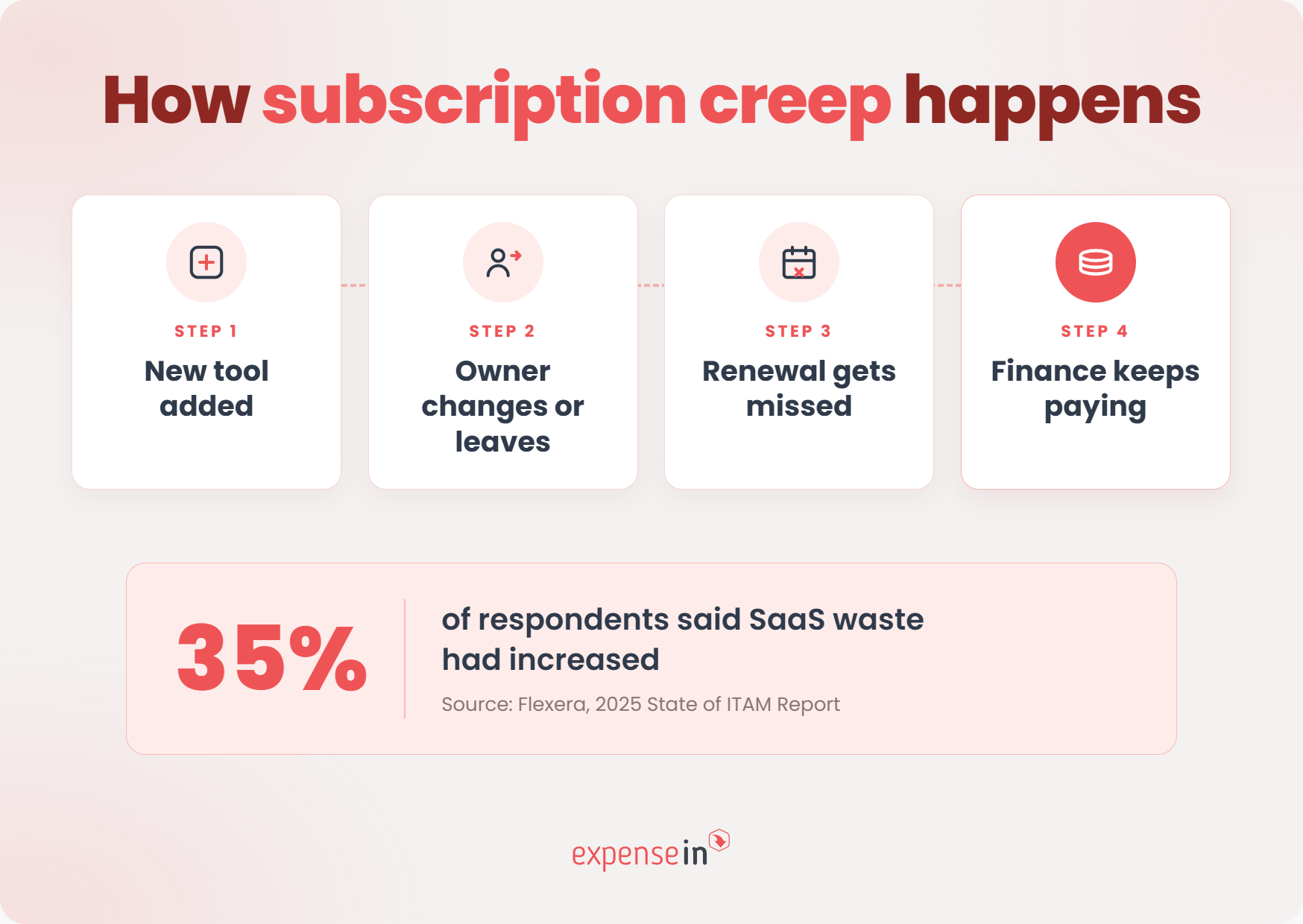
Subscription creep usually comes from a combination of small gaps:
Free trials convert into paid plans. The person who signed up forgets the renewal date.
Teams buy software independently. Finance sees several vendors but doesn’t always know who owns each one.
Licences survive employee departures. The employee leaves, but their software access and billing remain active.
Teams buy overlapping tools. Different departments solve the same problem with different subscriptions.
Annual renewals fall off the radar. A charge that appears once a year is easy to forget until it lands again.
Ownership changes. The person who originally bought the software moves role, leaves, or stops using it.
 And SaaS spending itself isn’t slowing down.
Gartner forecast worldwide spending on cloud application services, or SaaS, at $299.1 billion in 2025, up 19.2% from 2024.
At the same time, Flexera’s 2025 State of ITAM Report found that 35% of respondents said SaaS waste had increased over the previous year. Only 59% were actively tracking SaaS usage, while 56% were rightsizing contracts and subscriptions.
Becky Trevino, Chief Product Officer at Flexera, puts the visibility problem simply:
“You can’t optimise what you can’t see.”
That applies just as neatly to finance.
If recurring software payments are buried across shared company cards, invoices, and different departmental budgets, controlling them gets much harder.
There isn’t one payment method that’s right for every business.
The important question is: what you need the card to do beyond making the payment?
Card setup | Per-vendor control | Spend visibility | Reconciliation | Funding & rewards |
|---|---|---|---|---|
Business credit card | Usually limited unless the provider adds controls | Often cardholder- or statement-led | Depends on provider and accounting setup | Credit line typically available; cashback depends on card |
Business debit/current-account card | Usually limited | Usually statement-led | Depends on banking and finance workflow | No credit line; cashback depends on provider |
Standalone virtual cards | Often strong | Strong at card level | Depends heavily on integrations | Cashback depends on provider; credit depends on underlying account |
Expense management cards | Can combine card-level controls with expense data | Usually stronger for finance workflows | Can connect payment and expense processes | Cashback and credit availability depend on provider |
Let’s look at those trade-offs in practice.
Traditional business credit cards have clear advantages.
They can provide:
Access to credit
Payment flexibility
Rewards or cashback, depending on the card
A familiar payment process for finance teams and employees
That makes them a sensible option where working-capital flexibility matters.
The challenge comes when one card becomes the payment method for dozens of recurring suppliers.
Finance may be able to see what was charged, but still need to work out:
Who owns the software?
Which team uses it?
Is the amount expected?
When does it renew?
Is it still needed?
The card makes the payment. It doesn’t necessarily give finance the controls needed to manage the subscription itself.
Using an existing business debit card is straightforward.
For a handful of subscriptions, that might be enough. As the number of recurring payments grows, the shared-card model becomes harder to manage.
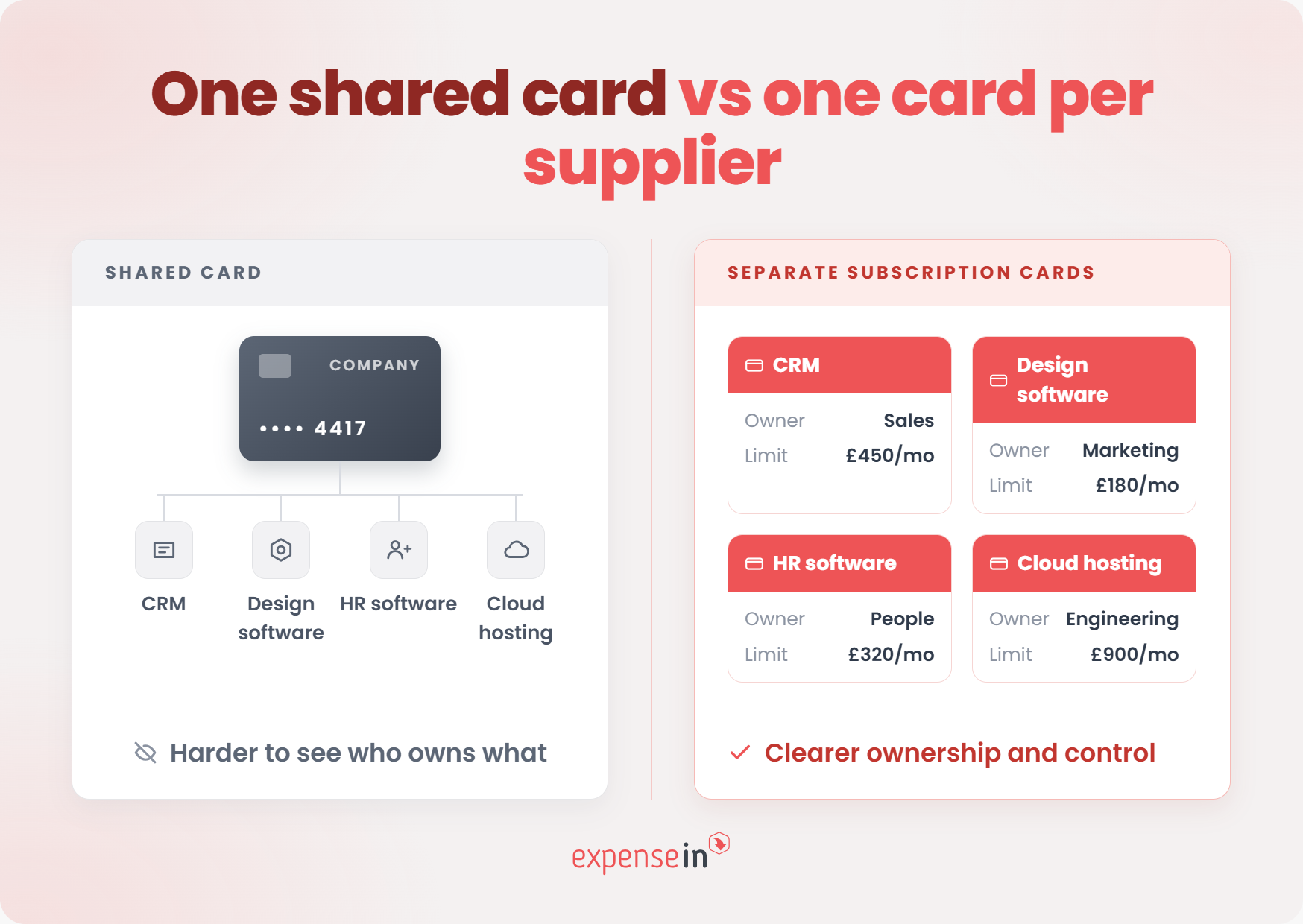
If 40 suppliers are using the same card details:
Those transactions are tied to one payment method.
Replacing the card can affect every connected subscription.
Vendor ownership may sit outside the payment record.
Finance still has to rebuild the context around each transaction.
Five subscriptions on a shared card is one thing. Fifty is another.
 Standalone virtual cards: better control, but check where the data goes
Virtual cards give businesses separate card details without needing a new physical card for every use case.
For subscription spend, that opens up a much cleaner model:
CRM platform: one virtual card
Design software: one virtual card
Cloud provider: one virtual card
Recruitment software: one virtual card
If one subscription ends, its card can be dealt with independently. That’s useful.
But there’s another question finance needs to ask: What happens after the payment?
A standalone virtual-card provider may give you excellent card controls while still leaving your finance team to move transaction data, documentation, and coding between separate systems.
When comparing virtual cards for subscriptions, look beyond card creation. Check how the transaction reaches your expense and accounting workflow.
Expense management cards bring card activity and finance processes into the same environment.
ExpenseIn separates two common types of company spending.
Expense cards are designed for employee purchases. They use a shared issuing balance, support spending controls, and create a draft expense when a transaction takes place. Merchant information is pre-filled so the expense can move through the usual receipt and approval workflow.
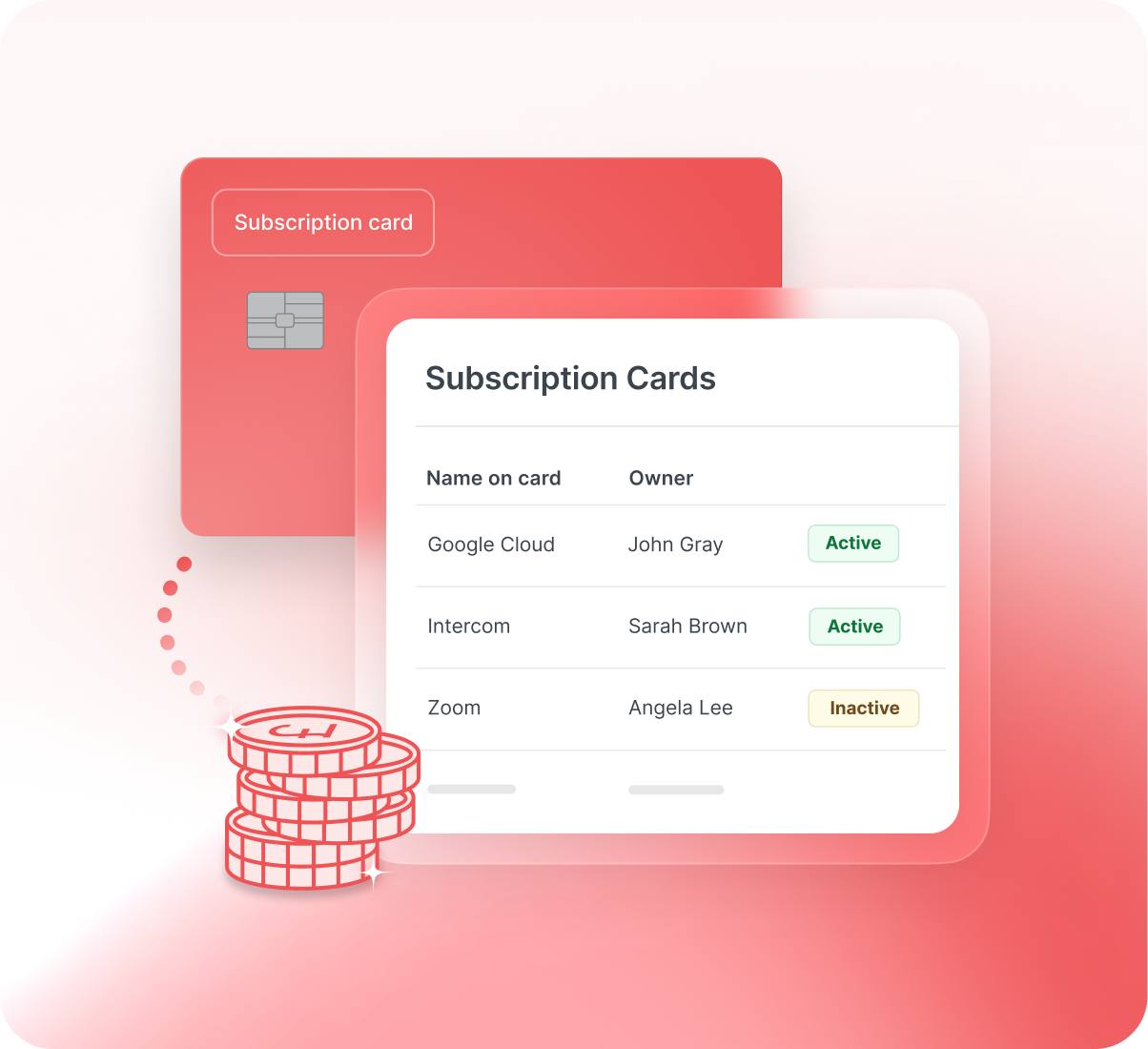
Subscription cards are different. They’re company-level virtual cards designed for recurring suppliers, digital spending, and subscriptions. Each card has a named owner, and finance can apply its own spending controls. Subscription card payments don’t create an employee draft expense. They’re reconciled through the Cards transaction workflow instead.
That separation is important.
Employee spending and recurring supplier spending are different finance jobs. There’s little value in forcing them through an identical process.
Want to see how ExpenseIn handles employee card spend and recurring supplier payments? Book a demo.
If you’re comparing a virtual card vs credit card for subscriptions, start with the reason you need the card.
You want to separate suppliers onto different payment details.
You need spending controls at vendor level.
Clear ownership matters.
You want to stop one card without disrupting unrelated suppliers.
Recurring-spend visibility matters more than access to credit.
A credit facility is an important part of your cash-flow strategy.
The issuer’s payment terms matter to the business.
The rewards or other card benefits justify the setup.
You’ve got another reliable way to track ownership and recurring spend.
It doesn’t have to be either/or. A finance team can use different payment methods for different jobs.
The important part is avoiding a setup where every recurring supplier gets put onto one card simply because that’s the card everyone already has.
The model is simple.
Instead of sharing one set of company card details across a long list of SaaS providers, give important recurring suppliers their own cards.
For example:
Supplier | Card | Owner | Limit |
|---|---|---|---|
CRM platform | CRM Subscription Card | Sales Ops | £X/month |
Design software | Design Subscription Card | Marketing | £X/month |
Cloud hosting | Hosting Subscription Card | IT | £X/month |
HR software | HR Subscription Card | People | £X/month |
Now each recurring payment has context before the transaction even happens.
With an ExpenseIn subscription card, finance can:
Create a company-level virtual card for the recurring supplier.
Assign an owner who’s responsible for that supplier payment.
Set spending controls, including merchant-category restrictions, merchant-country restrictions, allowed spending days, and limits.
Choose the relevant limit interval, such as daily, weekly, or monthly.
Monitor transactions through the Cards module.
Reassign ownership if responsibilities change.
That last point is particularly useful when somebody leaves.
You don’t necessarily want an important business subscription to stop because its original owner has left the company.
With ExpenseIn subscription cards, the card’s owner can be reassigned without issuing a replacement card.
A zombie subscription isn’t just software nobody uses. It’s software nobody is actively responsible for stopping.
If you want to stop forgotten renewals, start by making ownership visible
Start by giving every significant subscription three things:
A named owner: someone who’s accountable for whether the tool is still needed.
A distinct payment method: so finance can identify, control, and stop the supplier independently.
A review trigger: so the subscription gets questioned before it quietly renews again.
Then build subscription reviews into events that already happen inside the business.
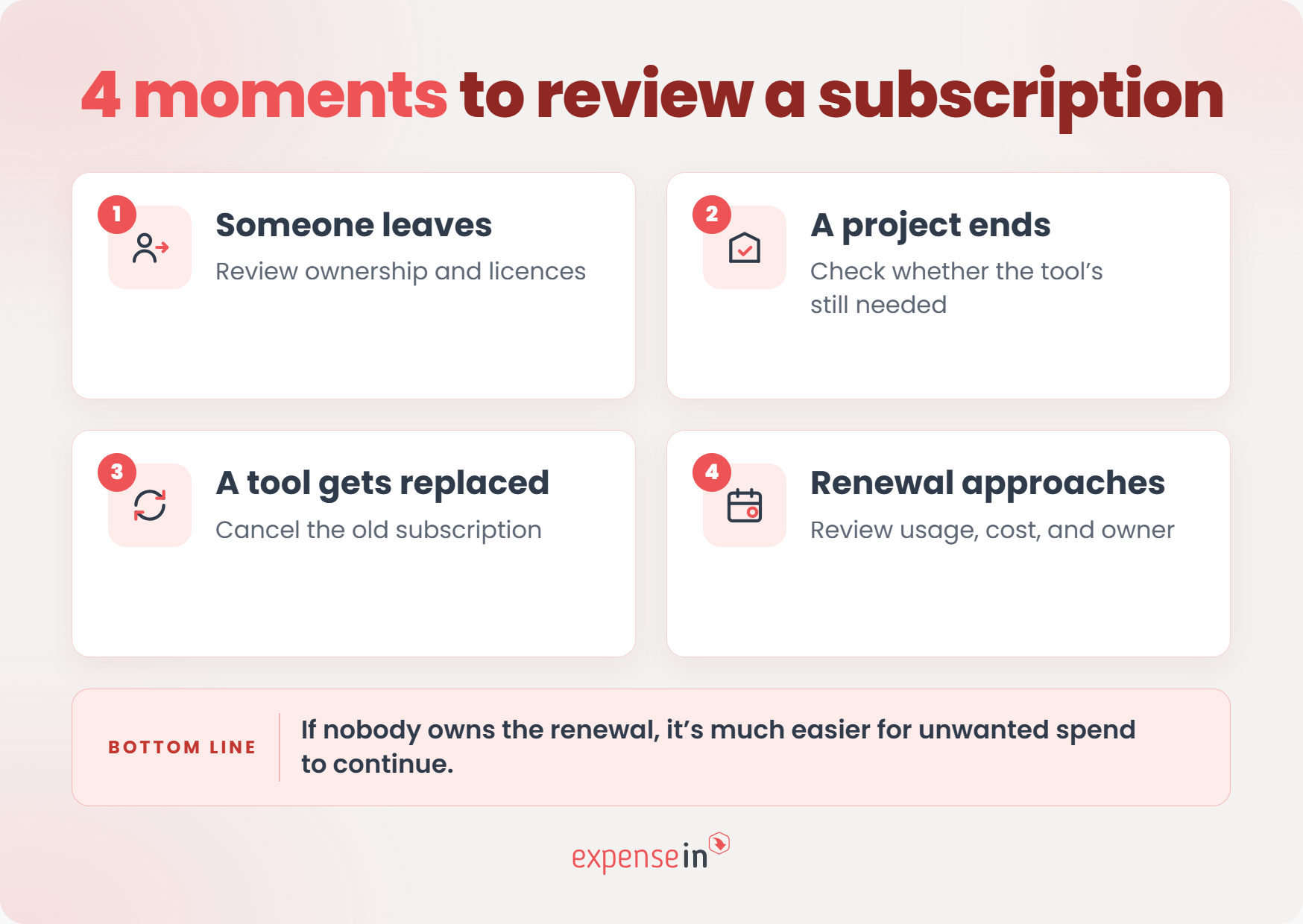 When an employee leaves
Check which software subscriptions they own.
Then decide whether to:
Reassign the subscription,
Reduce the licence count, or
Cancel the service.
If the service stays, change the owner. If it goes, cancel the subscription and stop its payment card.
Review any recurring software bought specifically for that project.
Temporary tools have a habit of becoming permanent costs when nobody gets the job of cancelling them.
Don’t rely on someone remembering to cancel the old subscription later.
Include cancellation in the implementation checklist.
Ask:
Are we still using it?
How many licences do we actually need?
Has the price changed?
Does another tool now cover the same job?
Who owns the budget?
Are we happy for it to renew?
ExpenseIn subscription cards can be edited individually, including changing spending controls, and can be managed separately from other cards.
The result is a much cleaner workflow than discovering an unwanted renewal after it’s already hit the statement.
“Offers virtual cards” isn’t enough information to make a buying decision. Finance needs to know what can actually be controlled.
When you’re comparing business expense cards for SaaS spend, check for:
Card-level limits: Can you set an appropriate ceiling for each supplier?
Different limit periods: Can limits run daily, weekly, or monthly?
Merchant controls: Can the card be limited by merchant category?
Country restrictions: Can finance block or allow transactions based on merchant country?
Spending days: Can the card be restricted to particular days where needed?
Individual card management: Can finance change or stop one card without touching the rest?
Named owners: Is responsibility for the recurring payment visible?
Real-time control changes: Can finance amend restrictions quickly?
Expiry controls for temporary cards: Can short-term virtual cards stop working when a project or buying window ends?
ExpenseIn subscription cards support merchant-category restrictions, merchant-country restrictions, allowed spending days, and spending limits. Limits can use intervals including daily, weekly, or monthly.
ExpenseIn’s virtual expense cards can also be used for temporary or project-based spend where expiry controls make more sense.
The goal isn’t to add restrictions for the sake of it. The card should reflect the spending decision finance has already approved.
Subscription control gets plenty of attention. Reconciliation is where finance often feels the admin.
A card statement tells you that money moved. Finance may still need to establish:
What the payment was for
Which supplier it belongs to
How it should be coded
What supporting documentation is available
Which entity, cost centre, or department owns it
How the transaction gets into the accounting system
That’s why a card shouldn’t be assessed separately from the rest of the finance workflow.
ExpenseIn’s current accounting integrations include AccountsIQ, Xero, Sage, and QuickBooks, among others.
Its direct integrations can support activities such as posting expense and invoice data, and synchronising relevant accounting reference data, depending on the integration.
There’s also an important distinction between expense cards and subscription cards.
A draft expense is created.
Merchant details are pre-filled.
The cardholder can add the required receipt.
The expense can move through the approval process.
No employee draft expense is created.
The recurring supplier payment remains separate from employee spend.
Reconciliation is managed through the Transactions section of the Cards module.
You’ll still need the appropriate evidence for your accounting and VAT processes.
UK businesses should check current HMRC guidance, and Irish businesses should check current Revenue guidance, for the evidence and records relevant to their circumstances. If you’re unsure, confirm the treatment with your adviser.
There’s another reason to question the “one card for every supplier” setup: concentration.
If one set of card details is used across dozens of online suppliers, a problem with that card can affect dozens of services.
Vendor-specific virtual cards reduce that dependency.
That doesn’t make fraud disappear, and virtual cards shouldn’t be presented as risk-free. But separate card details let finance contain changes to the supplier or use case involved.
The wider card-fraud numbers underline why online payment controls matter. UK Finance reported that remote-purchase card fraud losses increased by 3% to £423.5 million in 2025. Cases increased by 13% to 3.2 million.
Ruth Ray, Managing Director of Economic Crime at UK Finance, described the wider problem starkly:
“Fraud operates on an industrial scale.”
The practical lesson for subscription management isn’t that one type of card can remove fraud. It’s that finance should avoid unnecessary dependence on a single set of payment details.
With separate cards, a problem involving one supplier doesn’t automatically mean replacing the card used for every other recurring payment.
A subscription-heavy business may already be putting a significant amount of predictable spend through cards every month.
So, it’s reasonable to ask whether that spend can earn something back.
Eligible ExpenseIn customers can currently receive up to 0.75% cashback on ExpenseIn Card spend, depending on plan – this can include card spend such as subscriptions and software renewals. ExpenseIn Cards are currently available to businesses based in the UK and Ireland.
 Cashback shouldn’t be the main reason to choose a card platform, though.
Start with:
Control
Ownership
Fit with your wider finance process
Then look at cashback as an additional benefit on qualifying spend.
 How to choose the right card for a subscription-heavy business
Take your ten biggest recurring suppliers and test each prospective card setup against them.
For every provider, ask:
Can you issue different virtual cards for different recurring vendors?
Look beyond a simple monthly cap.
Check whether you can control merchant categories, countries, spending periods, and individual cards.
If finance can see a charge but can’t see who’s responsible for it, you’ve only solved half the problem.
Can ownership move without breaking an important supplier payment?
Cancelling a £100-a-month tool shouldn’t require changing card details across your whole SaaS estate.
The earlier finance sees recurring spend, the easier it is to spot unexpected payments.
Ask exactly where transactions, coding, receipts, invoices, and supporting data go.
Don’t settle for the word “integration”.
Check what information moves between the two systems, and how.
If access to a credit line is important, a traditional business credit card may still have an important role.
Check eligibility, plans, caps, fees, exclusions, and other applicable terms before comparing headline percentages.
For a subscription-heavy business, a good card setup should give finance more control before the payment happens, more context when the transaction appears, and less detective work when it’s time to reconcile it.
For many subscription-heavy businesses, dedicated virtual or subscription cards are a practical choice because different suppliers can be separated onto different payment details.
That can give finance clearer ownership, individual spending controls, and the ability to stop one supplier’s payment card without affecting unrelated subscriptions.
If access to a credit facility is important, a traditional business credit card may be more appropriate.
Choose a virtual or subscription card when vendor-level control, separation, and visibility are your main priorities.
Choose a business credit card when access to credit or the issuer’s specific card benefits are more important.
Some businesses use both for different types of spend.
Give every significant subscription a named owner, a review point, and a payment method finance can identify.
Then review subscriptions when:
Employees leave,
Projects finish,
New software replaces old software, and
Annual renewals approach.
If the tool’s no longer needed, cancel both the subscription and its dedicated payment card.
Yes, depending on the card provider and its terms.
Eligible ExpenseIn customers can currently receive up to 0.75% cashback on qualifying ExpenseIn Card spend, depending on plan, including eligible software and subscription spend. The ExpenseIn Card is currently available to businesses based in the UK and Ireland.
Virtual cards can reduce the dependency created by sharing one set of card details across many suppliers.
They don’t remove fraud risk, so businesses should still use suitable controls, authentication, monitoring, and internal processes.
For recurring spend, one practical advantage is containment: if one supplier relationship or card needs attention, other subscriptions can remain untouched.
The problem with subscription spend is losing track of what’s being paid for, who owns it, and whether it should still be renewing.
A shared card can make that harder.
Giving recurring suppliers their own controlled virtual or subscription cards creates a clearer structure:
One supplier
One payment method
One owner
Defined spending controls
A clear route to stop the payment when it’s no longer needed
ExpenseIn combines company expense cards and subscription cards with spending controls, real-time transaction visibility, and expense management workflows.
See how ExpenseIn can help you bring recurring and employee card spend under clearer finance control. Book a demo.
Learn the pros and cons of corporate cards and expense reimbursements, and how UK finance teams are managing both with smarter tools.