
Business Expenses
Corporate Cards vs Expense Reimbursements: Which is Best for Your Business?
Learn the pros and cons of corporate cards and expense reimbursements, and how UK finance teams are managing both with smarter tools.
An employee pays £300 for a hotel, train ticket, or piece of equipment needed for work. They’re waiting to be reimbursed. Finance still needs to check the evidence, apply policy, approve the claim, make the payment, and keep the right record.
Expense reimbursement is the process of paying an employee back for approved business costs they’ve paid personally.
The employee records the expense and supporting evidence, submits a claim, the employer checks it against company policy and relevant HMRC rules, then approves and pays the amount due.
In simple terms:
The employee incurs an approved business cost.
They record the expense and supporting evidence.
The claim is checked and approved.
The employer reimburses the employee and records the transaction.
For finance, the challenge is paying legitimate employee spending without creating weak evidence, policy exceptions, incorrect tax treatment, or another layer of payment admin.
This article provides general information only. Tax and National Insurance treatment depends on the particular expense and circumstances. Check current HMRC guidance and seek professional tax, payroll or legal advice where appropriate.
Expense reimbursement is when an employer pays an employee back for an approved business cost the employee originally paid for with their own money.
For example, an employee might pay out of pocket for business travel, accommodation, or work-related supplies, then submit the cost to their employer for repayment.
Two distinctions matter:
It’s not salary. Salary pays an employee for their work. Reimbursement pays them back for a business cost they have already covered.
It’s not the same as claiming tax relief from HMRC. If an employer doesn't repay the full cost of an eligible job expense, the employee may be able to claim tax relief on the unpaid qualifying amount. See HMRC’s guidance on claiming tax relief for job expenses.
Expense reimbursement is widespread among UK employers.
HMRC-commissioned research found that 59% of employers reimbursed employee expenses, rising to 90% of medium-sized employers and 98% of large employers.
Say an employee pays £120 for a train journey to meet a client using their own card.
The reimbursement could move through the business like this:
Expense: The employee pays £120 for the train ticket.
Evidence: They capture the receipt or booking confirmation.
Claim: They submit the expense with the relevant business details.
Check: The claim is checked against the company’s expense and travel policy.
Approval: The appropriate manager reviews the claim.
Reimbursement: Finance arranges payment of the approved amount.
Record: The expense, approval, and payment information is retained.
For finance, approval isn’t the end of the reimbursement process. The payment still needs to match the approved claim, reach the right employee, and be properly recorded.
A controlled reimbursement process gives employees a clear route to claim and finance enough information to decide what should be paid.
Employee action | Manager and finance action |
|---|---|
Incurs a business cost | Policy sets the rules before spend happens |
Captures the supporting evidence | Evidence requirements are checked |
Submits the claim and business context | Claim is routed to the right reviewer |
Responds to queries if needed | Claim is checked against policy |
Waits for the outcome | Approver approves, queries or rejects |
Receives reimbursement | Finance pays the approved amount and records it |
Before money is spent, the employee should be able to answer two questions:
Can I claim this expense?
Do I need approval before I spend it?
Your expense policy should provide those answers.
Acas recommends that an expenses policy sets out what the employer will pay, how payments are calculated, any limits, and the evidence employees need to provide. It also makes the expectation clear:
“If there is an expenses policy, the employer and employee should follow it.”
HMRC-commissioned research also found examples of employers requiring costs such as travel and accommodation to be approved by a line manager or director before the employee paid for them.
Some controls work better before an employee commits money than after the claim arrives.
Once the expense has been incurred, the employee should capture the evidence required by your policy.
Depending on the expense, that might include:
a receipt
an invoice
a booking confirmation
mileage or journey details
another accepted form of evidence
HMRC’s employer record-keeping guidance gives travel reimbursement as an example: employers should retain information showing when and why the employee travelled, with receipts kept where possible.
Evidence needs to show more than the fact that money changed hands. Finance may also need to understand why the business should bear the cost.
A claim should give the reviewer enough information to make a decision without having to chase the employee afterwards.
That will typically include:
amount
date
expense category
supporting evidence
business purpose, where relevant
project, client, or cost centre, where required
A receipt can show what was purchased. It doesn’t necessarily explain why the purchase was needed for work.
Finance and approvers should be able to answer:
Is this type of expense allowed?
Is it within the relevant limit?
Is the required evidence attached?
Was pre-approval required and, if so, obtained?
Is the business purpose clear?
Does the expense claim require an exception?
HMRC also has specific checking requirements for certain benchmark and bespoke scale-rate arrangements, including restrictions on employees checking their own expenses.
Not every reimbursement falls under those particular rules, but clear separation between the claimant and reviewer gives finance stronger control.
The claim should have a clear outcome:
Approve: the claim meets the relevant requirements.
Query: more information is needed.
Reject: the claim doesn’t meet the organisation’s requirements.
For unusual or out-of-policy expenses, recording why the decision was made gives finance a clearer audit trail and helps similar cases be handled consistently.
Once the claim is approved, finance needs to make sure:
the correct employee is paid
the payment matches the approved amount
the payment can be traced back to the claim
reimbursement status is recorded
the relevant data reaches the accounting process
If approved claims have to be exported, turned into payments elsewhere, checked again, and then matched back to individual expenses, finance is effectively managing a second workflow after approval.
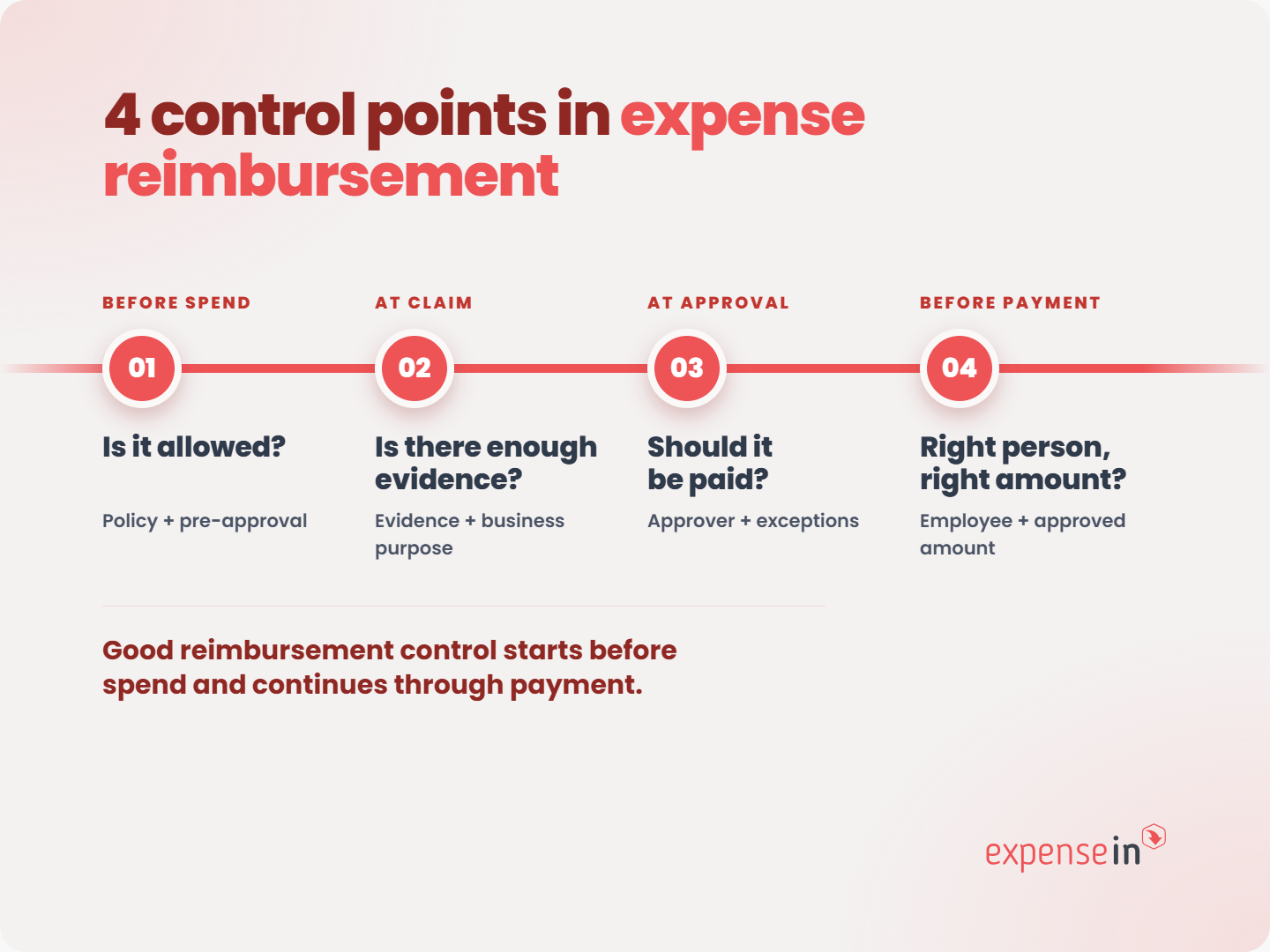
A controlled process keeps the chain connected:
expense → evidence → check → decision → payment → finance record
There isn’t a single HMRC list of expenses every employer must reimburse. What employees can claim will usually be set out in your organisation’s expense policy, while HMRC rules determine the relevant tax and reporting treatment.
Common categories include:
Expense category | Typical example | Point to check |
|---|---|---|
Rail or other travel required for work | The journey must meet the relevant business travel rules | |
Accommodation | An overnight stay required for business travel | The treatment depends on the reason for the underlying journey |
Meals and necessary costs while travelling for work | Specific travel and subsistence rules apply | |
Work supplies | Items bought for the business at the employer’s request | Your policy should define what employees are authorised to buy |
Professional fees and subscriptions | Membership of a relevant professional body | Tax treatment depends on the organisation and circumstances |
Business journeys made in an employee’s own vehicle | Separate HMRC mileage rules apply |
HMRC’s travel guidance includes costs such as accommodation, meals, parking charges, tolls, and congestion charges where the relevant travel and subsistence conditions are met.
HMRC-commissioned research into employer expenses found that, among the expense categories examined:
40% of employers reimbursed miscellaneous items bought for the company at its request.
34% reimbursed subsistence costs, including overnight accommodation.
33% reimbursed refreshments when employees attended meetings away from the office.
25% reimbursed professional fees required for an employee’s job.
19% reimbursed relevant, but non-compulsory, professional subscriptions.
15% reimbursed tools.
The research also found examples of employers setting reimbursement limits, particularly for accommodation and business travel.
One distinction is important: company approval doesn’t automatically determine the tax treatment.
Professional fees are a good example. An employer might choose to reimburse a subscription, but HMRC has separate rules covering when professional fees and subscriptions receive tax-exempt treatment.
HMRC generally treats journeys between an employee’s home and their permanent workplace as ordinary commuting.
Travel to a temporary workplace can be treated differently where the relevant conditions are met.
Journey | Typical treatment under HMRC guidance |
|---|---|
Home to the employee’s normal permanent workplace | Ordinary commuting |
Travel to a temporary workplace for a specific work requirement | Can qualify as business travel |
Travel from home or a permanent workplace to visit suppliers as part of the job | Can qualify as business travel |
A private journey where the employee happens to take work with them | Private travel |
See HMRC’s worked examples of business travel.
Being required to make a journey doesn’t necessarily make it business travel. HMRC gives the example of an employee who’s required to attend their permanent workplace outside normal working hours: the journey still counts as ordinary commuting.
Temporary workplaces, multiple workplaces, and homeworking can make the position more complicated, so check the relevant HMRC guidance where the circumstances aren’t clear.
Sometimes. The tax treatment depends on the expense and whether it meets HMRC’s conditions for an exemption.
Situation | Typical treatment |
|---|---|
The reimbursed expense qualifies for an HMRC exemption | No tax or National Insurance is normally due |
The reimbursement covers a non-deductible expense | It can be treated as earnings and processed through PAYE |
The employee isn’t fully reimbursed for an eligible expense | They may be able to claim tax relief on the unpaid amount |
HMRC’s expenses exemption can apply where an employer pays or reimburses an expense that would otherwise be fully deductible from the employee’s employment income.
This can cover qualifying costs such as business travel, associated subsistence, and certain professional fees and subscriptions.
If a reimbursement includes qualifying and non-qualifying costs, HMRC allows the qualifying amount to be treated separately where it can be clearly identified.
If an employer reimburses a non-deductible expense, HMRC says the reimbursed amount is treated as earnings and is subject to PAYE deductions.
An employee may be able to claim tax relief on the eligible amount their employer hasn’t repaid.
Tax relief isn’t a refund of the whole expense. HMRC gives the example of £60 of qualifying expenses for someone paying 20% tax, resulting in £12 of tax relief.
Tax treatment can vary by expense and circumstances, so check the relevant HMRC guidance or seek professional advice where needed.
Often, but not always. Your expense policy should state what evidence employees need to provide for each type of claim.
Acas recommends that expense policies cover evidence requirements, such as receipts or e-receipts. If the employee doesn’t have the required evidence, Acas says an employer may choose to accept an alternative, such as a bank statement or booking reference.
A receipt can show:
what was bought
how much was paid
when it was purchased
who supplied it
Other information may still be needed to establish the business purpose.
A missing receipt doesn’t automatically mean the claim has to be paid or rejected.
A simple exception process could be:
Explain why the receipt is missing.
Provide alternative evidence where available.
Review the claim against your policy.
Record the decision and any exception.
If the evidence required by the policy can’t be provided, the employer may decide not to reimburse the expense.
Mileage reimbursement is what an employer pays an employee for business journeys made in their own vehicle. HMRC calls these Mileage Allowance Payments.
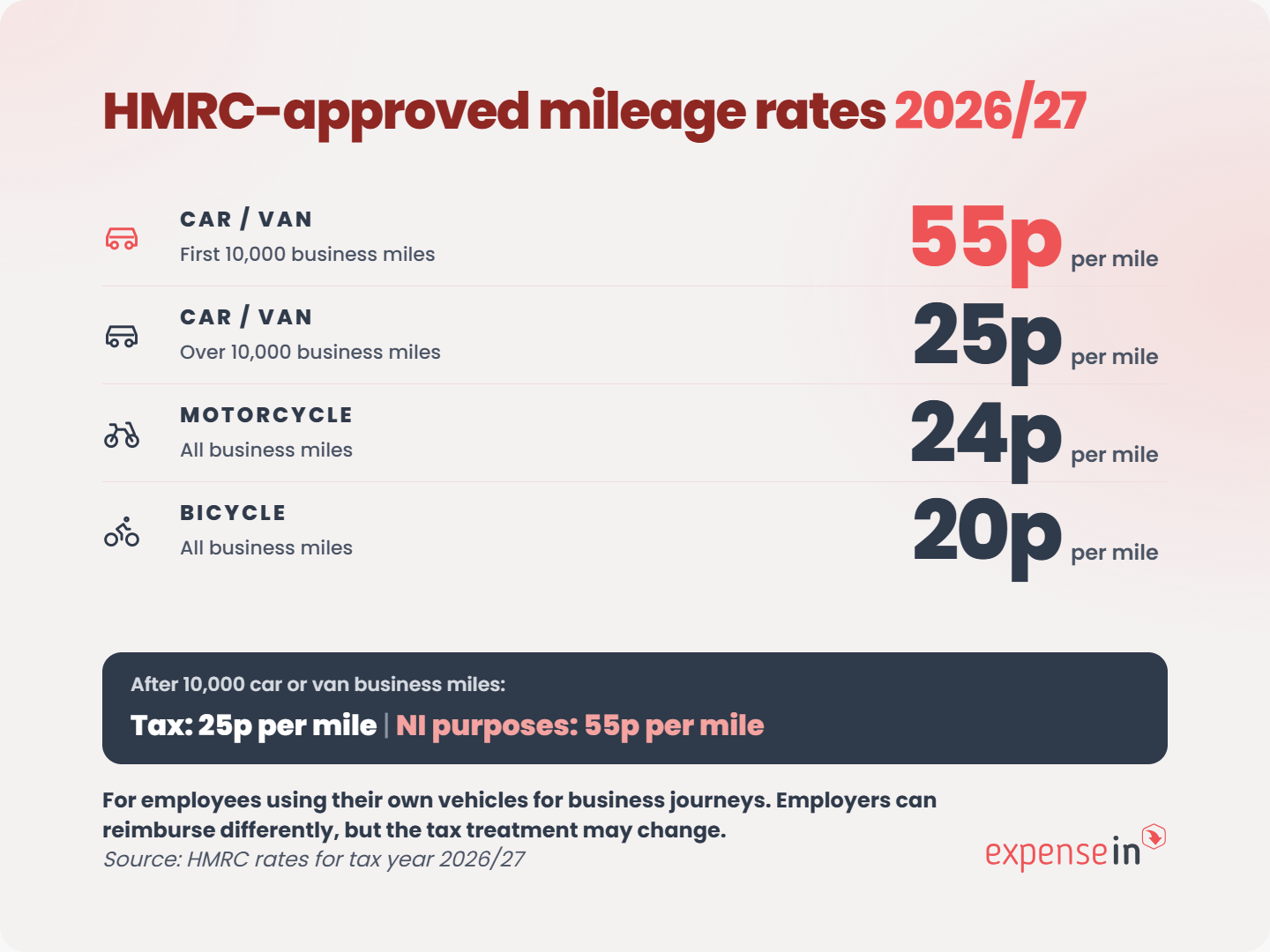
For the 2026/27 tax year, HMRC’s approved rates are:
Vehicle | Tax rate | National Insurance rate |
|---|---|---|
Car or van – first 10,000 business miles | 55p per mile | 55p per mile |
Car or van – over 10,000 business miles | 25p per mile | 55p per mile |
Motorcycle – all business miles | 24p per mile | 24p per mile |
Bicycle – all business miles | 20p per mile | 20p per mile |
For cars and vans, the first 10,000-mile tax rate increased from 45p to 55p, taking effect from 6 April 2026.
These are HMRC’s approved mileage rates, not mandatory employer reimbursement rates. Employers can choose to reimburse at a different rate, but that can affect the tax treatment.
One point for payroll teams: after 10,000 car or van miles, the approved tax rate falls to 25p per mile, while the rate for National Insurance purposes remains 55p for all business miles.
HMRC also provides a 5p per passenger per business mile rate where an employee carries a fellow employee in their car or van on a journey that is also a work journey for the passenger.
Your expense reimbursement policy should give employees and approvers one clear set of rules.
At minimum, cover:
what can and can’t be claimed
spending limits and pre-approval requirements
claim submission deadlines
who approves expenses and exceptions
reimbursement dates
travel, mileage, and foreign-currency rules
For a fuller breakdown, read our guide to creating a travel and expense policy, or use ExpenseIn’s free Travel & Expense Policy Template as a starting point.
Employees should know what’s allowed before they spend, and finance shouldn’t have to reinterpret the rules for every claim.
There isn’t a useful one-size-fits-all reimbursement timetable. What matters is setting a clear schedule and sticking to it.
Your policy should define:
claim cut-off dates
expected approval times
reimbursement dates
an escalation route for delayed claims
APQC’s cross-industry benchmarking puts the median time from receiving an expense report to approving and scheduling reimbursement at six calendar days, based on a sample of 5,038 organisations.
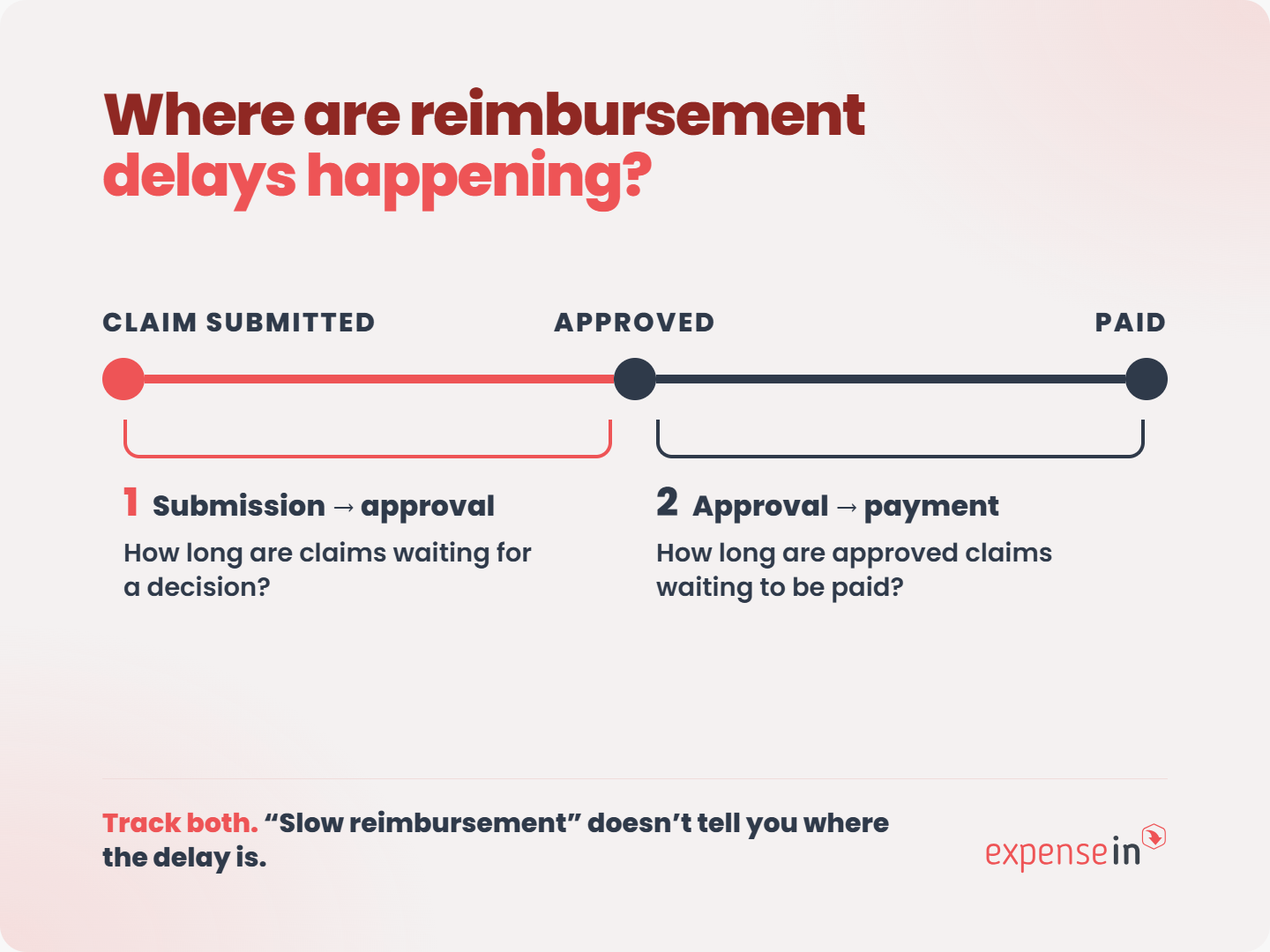
Finance should track claim ageing from submission to approval, and from approval to payment. That makes it easier to see where delays build up.
Speed matters to employees, too.
HMRC-commissioned research found that, among employers reimbursing the expenses examined, 45% cited improved staff satisfaction, and 42% cited staff retention as reasons for doing so.
Employees shouldn’t be left out of pocket for longer than necessary.
Finance should keep enough information to show what was reimbursed, why, and how it was accounted for.
HMRC says employer expense and benefit records should include:
the date and details of each expense or benefit
information used to calculate amounts reported to HMRC
any employee contribution
relevant correspondence with HMRC
For travel reimbursements, records should also show when and why the employee travelled.
These expense and benefit records must be retained for three years from the end of the tax year they relate to.
That three-year period isn’t a universal retention period for every finance document. Other VAT, accounting, payroll, or company-record requirements can have different rules.
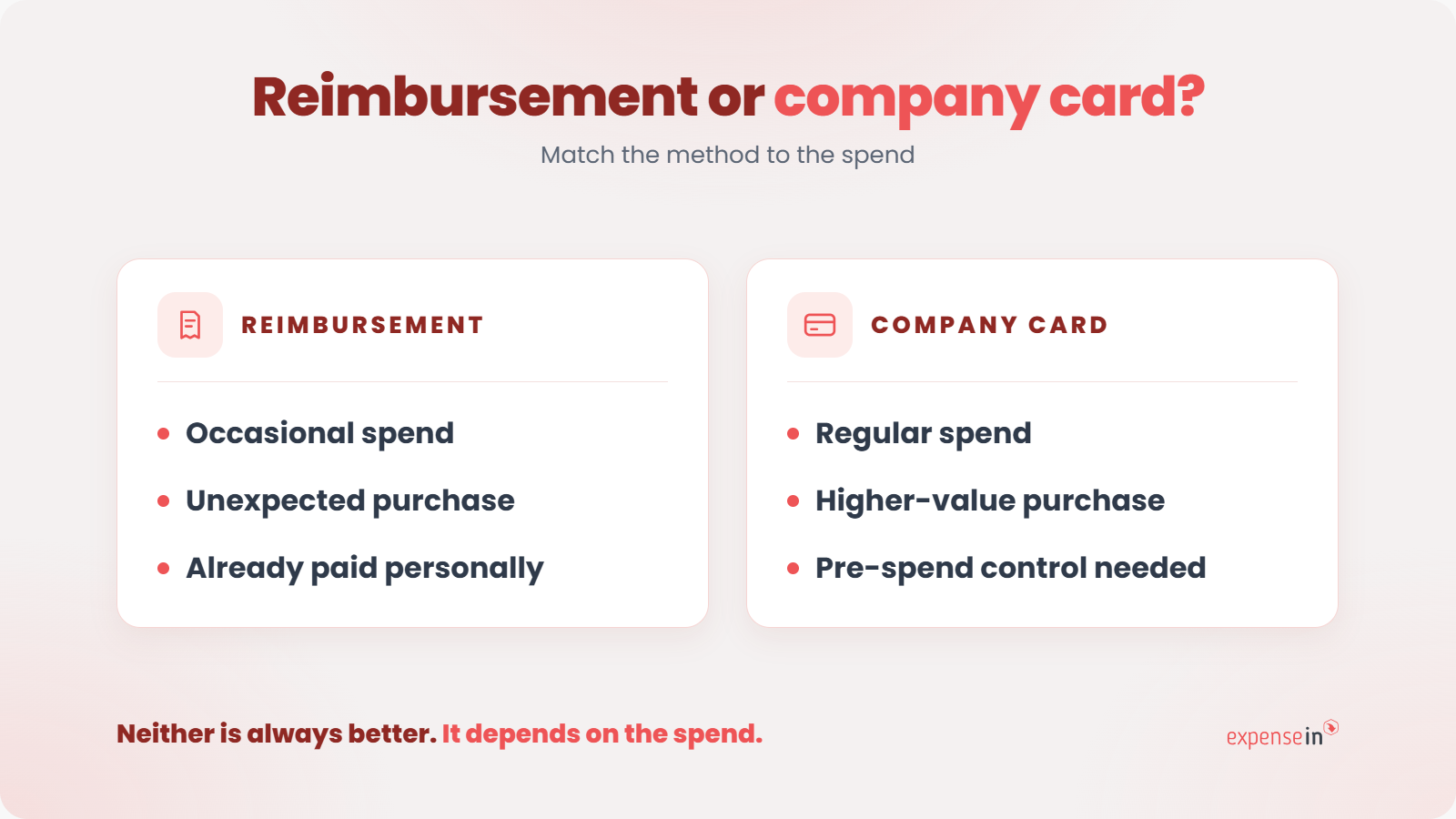
Reimbursements and company cards solve different spending needs.
Spend | Reimbursement may suit | Company card may suit |
|---|---|---|
Occasional or unexpected purchase | ✓ | |
Cost already paid personally | ✓ | |
Regular or predictable business spend | ✓ | |
Higher-value purchases | ✓ | |
Finance needs controls before money is spent | ✓ |
With the ExpenseIn Card, finance can apply spending controls around factors such as merchant categories, countries, spending days, and transaction values.
Physical and virtual expense card transactions automatically create draft expenses in ExpenseIn for the user to complete; Subscription card transactions work differently.
Reimbursement still has a role when an employee needs to pay personally. ExpenseIn Reimbursements keeps approved claims, reimbursement runs, and accounting data connected, while finance decides which approved expenses are included before funds leave.
A practical approach is to use cards where pre-spend control makes sense, and reimbursement where out-of-pocket spending is appropriate or unavoidable.
For a deeper comparison, see ExpenseIn’s guide, Corporate Cards vs Expense Reimbursements: Which is Best for Your Business?.
Reimbursement admin can add up quickly.
APQC’s current cross-industry benchmark puts the median at 7,500 T&E disbursements per full-time equivalent employee working on expense reimbursements, based on a sample of 1,668 companies.
That makes the hand-offs after approval worth looking at. If finance still has to prepare payments elsewhere, move data between systems, and match payments back to claims, the work continues after the expense has already been checked.
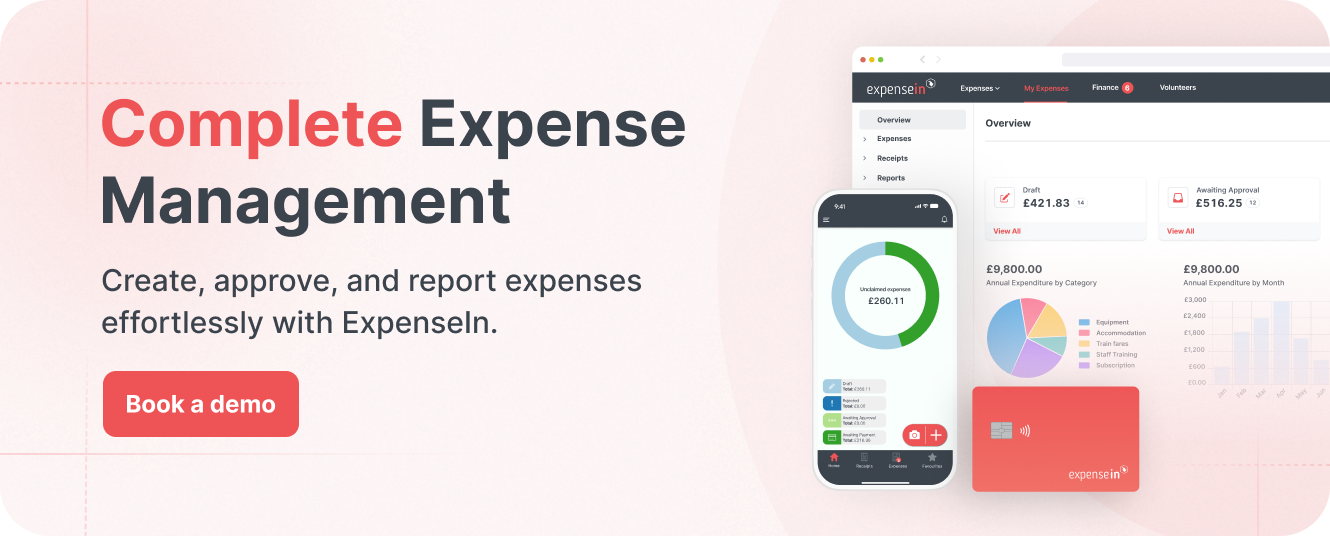
ExpenseIn Reimbursements keeps approved expenses and payments in the same workflow. Finance can choose which approved expenses go into a reimbursement run, review the details, and confirm what’s included before funds leave.
That gives finance:
Less payment admin: fewer separate payment steps and less information to move between systems.
More control: finance chooses what goes into each reimbursement run and checks it before payment.
One central pot: funds for approved reimbursements can be managed across teams and departments from one place.
Payment checks: Confirmation of Payee checks employee bank details and flags potential mismatches before reimbursement.
Faster Payments: UK reimbursements are made through Faster Payments and can also be scheduled for a chosen date or time.
Cleaner reconciliation: payments stay connected to the original expense and approval record.
Connected accounting: completed expense and reimbursement data is ready to sync with your accounting software.
The result is less work around the payment step, without taking control away from finance.
Use this as a quick sense-check of your reimbursement process:
Are employees clear on what they can claim?
Are limits, evidence requirements, and exceptions documented?
Are claims routed to the right approvers?
Are tax, mileage, and record-keeping rules applied correctly?
Can finance see where claims or approvals are delayed?
Are recurring out-of-pocket expenses better suited to company-funded spend?
Can finance control which approved claims get paid, and when?
Does reimbursement stay connected to the original claim, approval, and accounting record?
A good reimbursement process should repay employees promptly without weakening finance control.
Not necessarily.
Tax treatment depends on the expense and whether the relevant HMRC conditions are met. A qualifying reimbursement may fall within an exemption, while a non-deductible reimbursement can be treated as earnings and subject to PAYE.
Potentially.
HMRC says employees may be able to claim tax relief on qualifying job expenses paid with their own money. If the employer reimburses only part of the cost, relief can only be claimed on the qualifying amount left unpaid.
No. HMRC’s approved mileage rates determine how mileage payments are treated for tax purposes; they don’t set a universal rate that every employer must pay.
Employers can choose a different reimbursement rate, but the tax consequences can differ depending on whether the amount paid is above or below HMRC’s approved amount. Check the current HMRC rules when setting or updating your mileage policy.
Reimbursement shouldn’t become a separate finance process after a claim has already been approved.
ExpenseIn brings expense submission, approvals, reimbursement, and accounting data into one connected workflow. Finance can review what gets paid before funds leave, while employees get a clearer route from claim to repayment.
Learn the pros and cons of corporate cards and expense reimbursements, and how UK finance teams are managing both with smarter tools.