
Business Expenses
Cashback on Business Expenses: How to Get More Value from Company Spend
Learn how cashback on business expenses works, what spend may qualify, tax and accounting considerations, and how finance teams can judge the real value.
Ask a finance director whether they'd rather have spend control or cashback, and the answer is probably both. But in that order.
After all, no amount of cashback fixes a missing receipt at month-end.
New research commissioned by AccountsIQ and ExpenseIn among 150 finance leaders in the UK and Republic of Ireland backs this up. Expense tracking and visibility are still the priorities, but rewards have become an important consideration when choosing a provider.
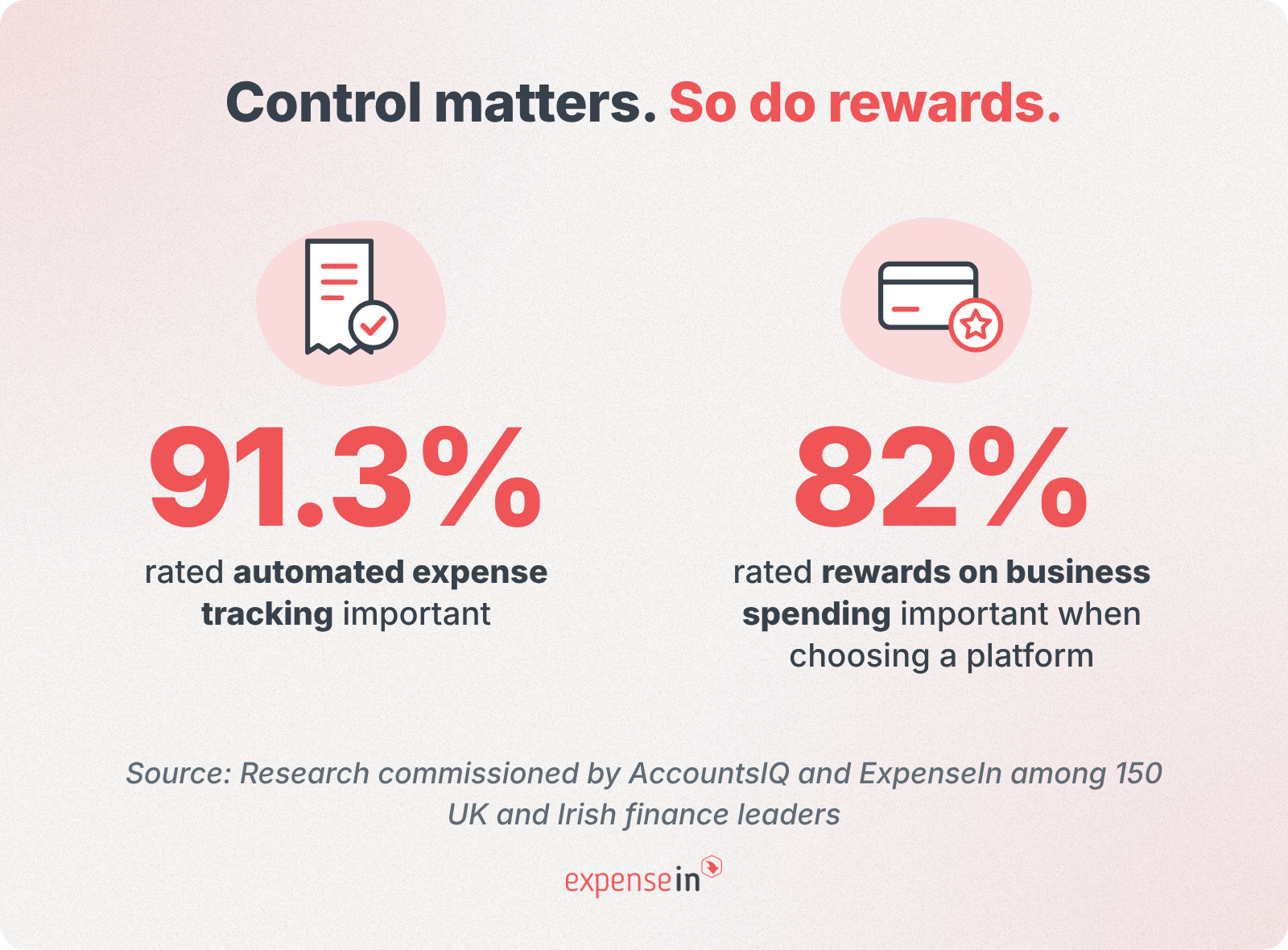
91.3% rated automated expense tracking important, the highest of seven features tested when choosing an expense management platform or company card provider.
85.3% expect cashback or rewards to influence their choice of finance software or expense provider over the next 12 months.
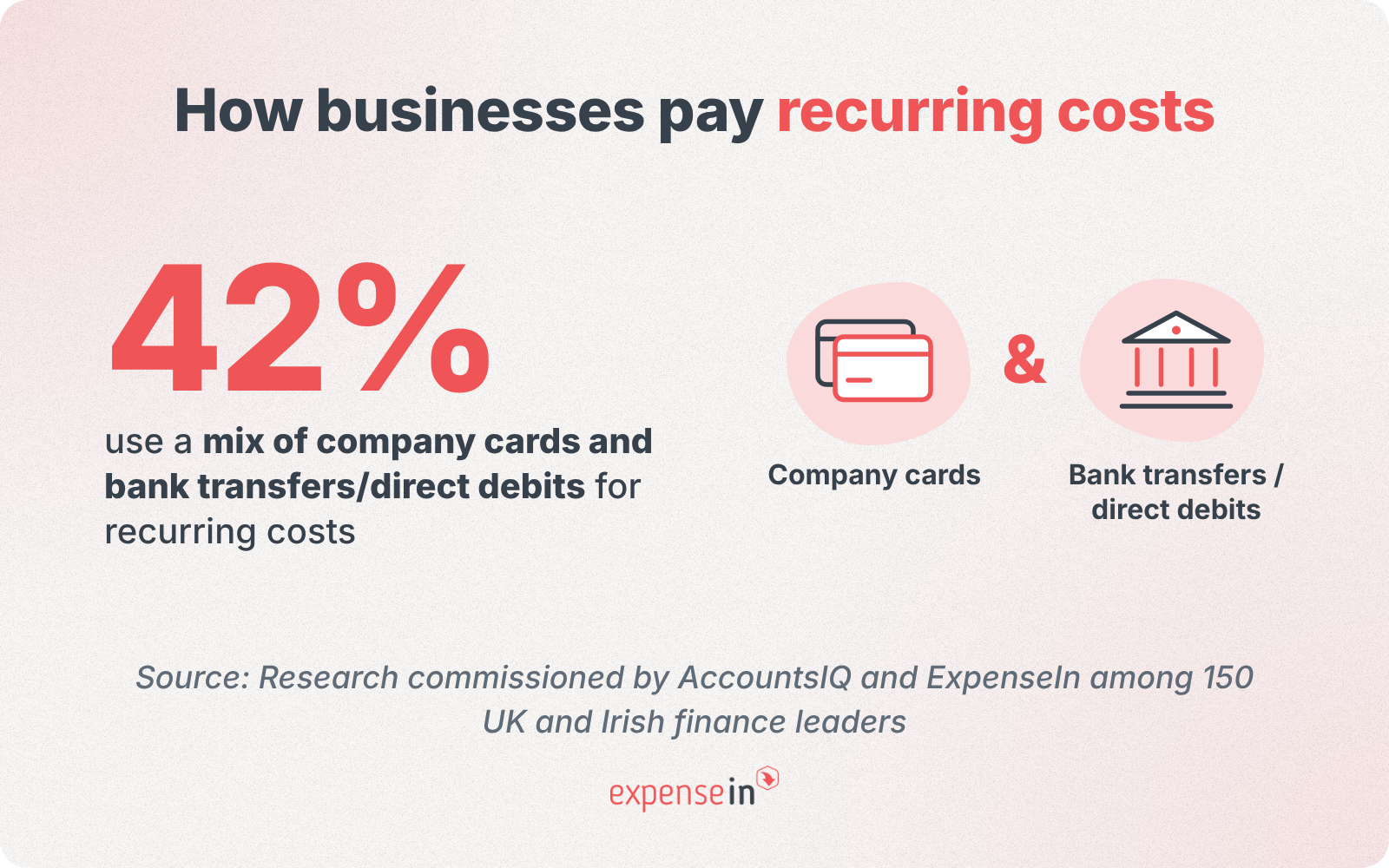
42% use a mix of company cards and bank transfers or direct debits to pay recurring business costs.
Finance teams want to keep spending under control. But they also want to know what they could be getting back from it.
When finance leaders rated seven expense platform features, the top three were all about managing spending rather than earning rewards.
Automated expense tracking came first, rated important by 91.3% of respondents, followed by real-time spend visibility at 88.7% and accounting software integration at 87.3%.
What respondents rated | Rated important |
|---|---|
Automated expense tracking | 91.3% |
Real-time visibility of expenditure | 88.7% |
Accounting software integration | 87.3% |
Rewards on business spending | 82% |
Custom spending controls | 82% |
Subscription/vendor-specific cards | 71.3% |
Cashback specifically | 70.7% |
Source: Research commissioned by AccountsIQ and ExpenseIn among 150 UK and Irish finance leaders (n=150). Percentages show respondents rating each feature very or fairly important when choosing an expense management platform or company card provider.
Cashback came last out of the seven features, but 70.7% still considered it important. Rewards on business spending scored even higher, at 82%, matching custom spending controls.
So while tracking, visibility, and accounting integration remain the main priorities, rewards are firmly on finance teams' radar too.
These findings reflect the seven features tested, rather than a ranking of everything an expense system should offer.
 Why finance teams prioritise automation and visibility
If you've ever closed out a month, you'll know why these features matter.
Take a £38 taxi fare after a client dinner in Manchester. Depending on the company's expense policy, someone needs to:
Collect the receipt
Match it to the expense
Check the claim
Obtain approval
Code the transaction before the books close
Miss a step and that £38 fare becomes another query for finance to resolve. Multiply that across dozens of employees and hundreds of transactions, and there's a lot of extra chasing to do.
Automation helps take some of that work off the team's plate.
An expense management system can capture transaction details, prompt employees for receipts, route claims through approval workflows, and give finance a clearer view of outstanding expenses.
There are still checks to be made. Employees need to provide supporting evidence, managers need to review claims, and exceptions need attention.
But with the right processes in place, finance can spend less time chasing information and more time dealing with the expenses that actually need investigating.
Cashback doesn't help much with any of that.
Even so, rewards carry weight when finance teams are choosing a provider.
85.3% of finance leaders expect cashback or rewards to influence their choice of finance software or expense provider over the next 12 months.
Nearly a quarter (24%) expect a major influence, while 61.3% expect some influence.
Only 13.3% expect little influence, and just 1.3% say rewards won't influence their decision at all.
That's a sizeable majority factoring rewards into their next purchasing decision.
The survey doesn't tell us whether finance leaders would accept weaker expense controls in exchange for cashback. What it does show is that rewards are on the list of things they're considering.
And once a platform meets the team's operational requirements, it's reasonable to ask whether the business could be earning something back on its existing spending.
Businesses don't always pay recurring costs through the same route.
According to the research, 42% of respondents use a mix of company cards and bank transfers or direct debits.
Another 27.3% primarily use bank transfers or direct debits, while 19.3% mainly use company cards. The remaining 11.3% have employees pay out of pocket and claim the cost back later.
How recurring costs are paid | Respondents |
|---|---|
Mix of company cards and bank transfers/direct debits | 42% |
Primarily through bank transfers/direct debits | 27.3% |
Primarily through company cards | 19.3% |
Employees pay out of pocket and claim back | 11.3% |
Source: Research commissioned by AccountsIQ and ExpenseIn among 150 UK and Irish finance leaders (n=150).
For finance, each method comes with its own records to manage.
Bank transfers and direct debits: Payments need matching against invoices and other supplier documentation.
Employee reimbursements: The business only receives the claim after an employee has already paid.
Company expense cards: Transactions can be recorded as purchases happen, particularly when cards are linked to expense management software.
Of course, a card payment still needs the right supporting information. Receipts, policy checks, and approvals don't disappear just because someone uses a company card.
Software subscriptions are a good example of how mixed payment methods can complicate things.
One subscription goes through direct debit, another is charged to an employee's personal card, and a third is paid using a company card.
All three are valid payment methods. But finance now has three different sets of records to bring together for one expense category.
That can mean more reconciliation work, less visibility over spending, and extra follow-up when something doesn't match.
 Where finance teams want to earn cashback
The research also asked finance leaders which areas of business spending they'd most like to earn cashback on. Respondents could choose up to three categories.
Business travel topped the list at 44%, followed by fuel and utilities at 34.7% each. Professional services and software subscriptions were both selected by 32%.
Cashback category | Respondents |
|---|---|
Business travel | 44% |
Fuel | 34.7% |
Utilities | 34.7% |
Professional services | 32% |
Software subscriptions | 32% |
Source: Research commissioned by AccountsIQ and ExpenseIn among 150 UK and Irish finance leaders (n=150). Respondents could select up to three categories.
There's a common thread here. These are familiar business costs that finance teams already budget for.
Take a sales team travelling to client meetings. Train fares, hotels, meals, and fuel can quickly add up.
If some of that spending qualifies for cashback, the business could earn a return on costs it was going to incur anyway.
It's a straightforward benefit: there's no need to find new things to spend money on just to earn a reward.
The UK and Republic of Ireland respondents shared some priorities, although the results weren't identical.
In both markets, 82% rated rewards on business spending as important when choosing an expense platform.
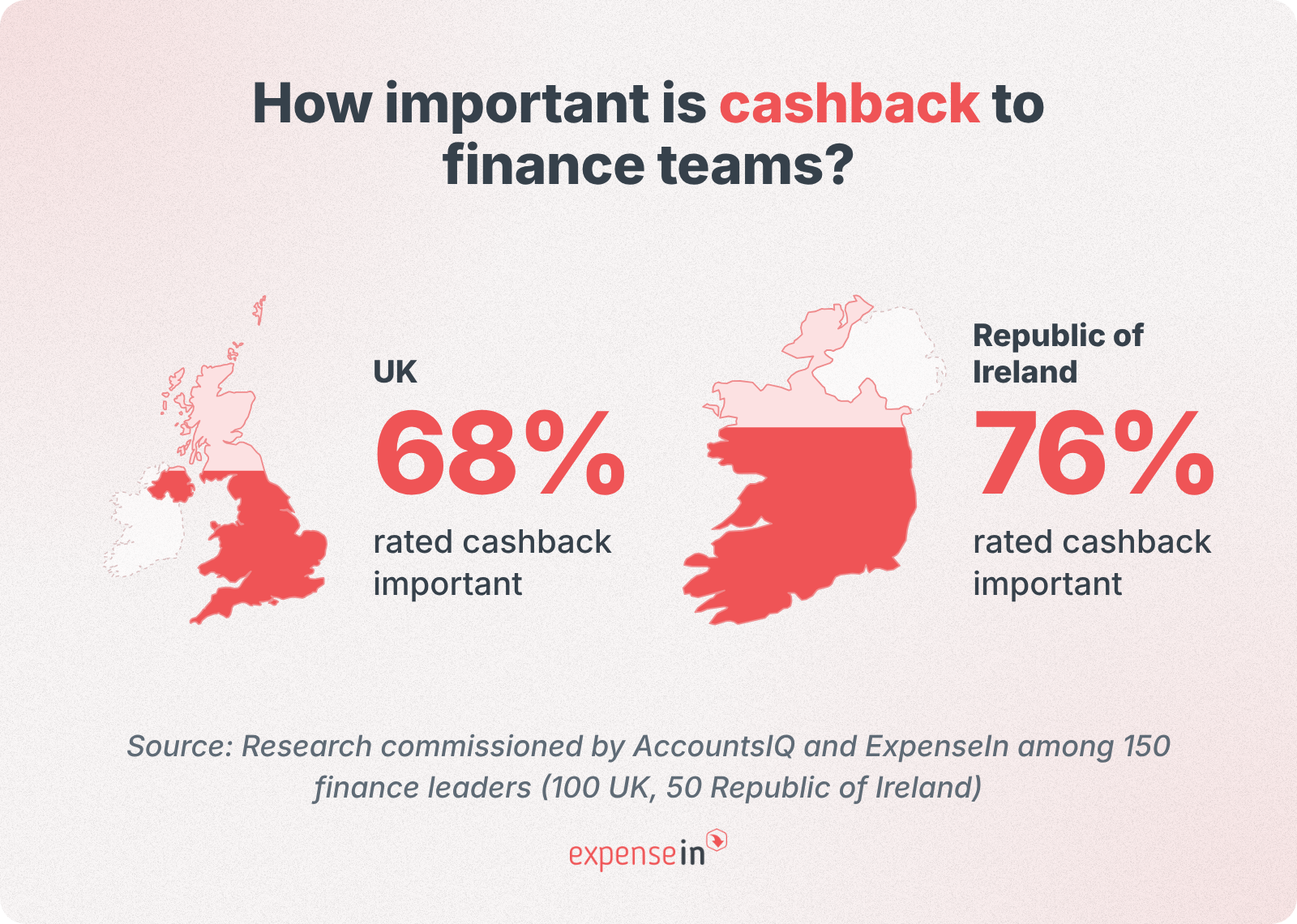
For cashback specifically, the figures were 68% in the UK and 76% in the Republic of Ireland.
Software subscriptions also scored the same in both markets, with 32% selecting them as a category where they'd like cashback.
One of the more noticeable differences was utilities, chosen by 44% of UK respondents compared with 16% in the Republic of Ireland.
Measure | UK | Republic of Ireland |
|---|---|---|
Rewards rated important | 82% | 82% |
Cashback rated important | 68% | 76% |
Software subscriptions wanted as a cashback category | 32% | 32% |
Utilities wanted as a cashback category | 44% | 16% |
Top choice for cashback reporting | 35% want it automatically visible within expense reports | 38% want it paid directly into the company account |
Source: Research commissioned by AccountsIQ and ExpenseIn among 150 finance leaders (UK: n=100; Republic of Ireland: n=50). Percentages are based on respondents in each market.
There were differences in reporting preferences, too.
In the UK, the most popular option was having cashback automatically visible within expense reports (35%, compared with 22% in the Republic of Ireland).
In the Republic of Ireland, respondents were more likely to prefer cashback paid directly into the company account (38%, compared with 28% in the UK).
The country samples are relatively small, particularly the Republic of Ireland group. Without further statistical testing, we can't draw firm conclusions about differences between the two markets.
Still, the reporting results raise a practical consideration for any finance team assessing cashback: where will the reward show up in your accounts?
Whether cashback appears in an expense report or is credited separately, finance needs to be able to trace it, understand how it's calculated, and record it correctly.
Otherwise, there's another transaction to investigate at month-end.
 What should finance teams look for in an expense platform?
Start with the expense management features your team needs, then work out whether cashback makes financial sense for the spending you already have.
Here's what to check when comparing providers:
Spend controls: Can you set appropriate limits and restrictions on who spends, where, and how much?
Recurring payments: Can subscriptions and supplier costs sit on dedicated cards with their own limits, rather than an employee's personal card?
Expense capture: How are card transactions, receipts, and employee claims recorded?
Real-time visibility: Can finance see spending before month-end?
Approvals and policies: Can expenses be reviewed and checked against company rules?
Accounting workflow: How will transactions, coding, and approved expenses feed into your wider finance systems?
Cashback eligibility: Which purchases qualify, what rate applies, and are there fees, exclusions, or caps?
Cashback reporting: Can finance trace the reward from the original spending through to the eventual credit?
The cashback rate is only one part of the decision. The time spent managing expenses, the quality of the controls, and how well the platform fits your finance processes matter just as much.
Our guide to cashback on business expenses explains how to calculate the actual return rather than relying on the headline rate.
Earning cashback is useful. But finance still needs to know who's spending what, where the receipts are, and what's waiting for approval.
ExpenseIn brings company cards and expense management together, so finance teams can manage card spending alongside receipts, approvals, reimbursements, and reporting.
With ExpenseIn expense cards, purchases can create draft expenses and prompt employees to add receipts for review and approval.
For recurring supplier costs, ExpenseIn subscription cards provide a separate way to manage payments, with their own spending limits and merchant-category restrictions.
Finance can track those transactions in ExpenseIn without relying on an employee's personal card.
Eligible businesses can also earn up to 0.75% cashback on qualifying ExpenseIn Card spending, depending on their plan.
So alongside the expense controls and reporting, there's the potential to earn something back on purchases the business already makes.
 Frequently asked questions
Expense automation scored higher. In the AccountsIQ and ExpenseIn survey, 91.3% rated automated expense tracking as important, compared with 70.7% for cashback.
The two features were rated separately rather than as a direct choice.
85.3% expect cashback or rewards to have some or major influence on their next provider choice, including 24% who expect a major influence.
Business travel came top at 44%, followed by fuel and utilities (34.7% each), then professional services and software subscriptions (32% each).
Respondents could choose up to three categories.
The most popular options were payment into the company account (31.3%) and visibility within expense reports (30.7%).
Other preferences included a separate cashback dashboard (20.7%) and monthly statements (16%).
Eligible businesses can earn up to 0.75% cashback on qualifying ExpenseIn Card spending, depending on their plan. Eligibility conditions, exclusions, and limits apply. Check the current plans for details.
Finance teams shouldn't have to give up spend controls to earn cashback.
The research shows that expense tracking, visibility, and rewards all feature in how finance leaders assess platforms. But the controls still need to work, regardless of what the business earns back.
Before choosing a provider, check how spending is captured, approved, and reported. Then look at which of your existing costs qualify for cashback and calculate what you could actually receive after any conditions or limits.
It's a better way to judge the value of a platform than looking at the cashback rate alone.
Want to know whether ExpenseIn ticks the boxes for your finance team? Book a demo, and we'll show you how the spend controls, expense tracking, and cashback work in practice.
Methodology: Research commissioned by AccountsIQ and ExpenseIn among 150 CFOs, finance directors, heads of finance, and financial controllers (100 UK, 50 Republic of Ireland) at businesses with 50-500 employees. Fieldwork: 5-12 August 2026.
Learn how cashback on business expenses works, what spend may qualify, tax and accounting considerations, and how finance teams can judge the real value.